How to Compare Crypto Coin Trading Apps Like Robinhood: Fees and Security
What Is a Crypto Coin Trading App
A crypto coin trading app lets you buy and sell digital assets from your phone or browser. Think of it as a gateway to markets that never close. The crypto coin trading app space has grown fast, with hundreds of options now available.
Not all apps are the same. Some focus on Bitcoin only. Others offer dozens of coins and advanced tools. The right choice depends on what you trade, how often you trade, and how much risk you accept.
Market Context
Crypto trading apps range from simple custodial exchanges to advanced platforms with futures, APIs, and social features. After the FTX and Voyager collapses in 2022, investors started paying more attention to proof of reserves, insured custody, and transparent business models.
The distinction between regulated cash balances and uninsured crypto assets matters a lot. Many platforms hold your crypto in cold storage, but that does not mean it is backed by government insurance.
Robinhood and Its Limits
Robinhood helped bring commission-free trading to millions. Its crypto offering, however, has a limited coin selection and fewer advanced features than dedicated exchanges. The U.S. crypto selection is reported as roughly 18 to 50 coins, depending on the source and date.
Robinhood carries regulatory history that may matter when you compare alternatives. The platform received a $26 million FINRA fine for violations including anti-money-laundering failures. The 2021 GameStop incident is also part of its public history.
What to Compare in a Crypto Trading App
When you look at apps for crypto trading, check several things at once. Coin selection, fees, security, ease of use, and trading features all matter. A crypto coin trading app that looks cheap on fees may hide costs in spreads and routing.
Coin Selection and Network Coverage
- Coin count matters when you need exposure beyond Bitcoin and Ethereum. Reported platform catalogs range from five assets on Fidelity to more than 550 on Kraken.
- Some apps specialize in a narrower range. Swan and Cash App support Bitcoin only. PayPal supports BTC, ETH, LTC, BCH, and PYUSD.
- A large catalog does not by itself establish liquidity, custody quality, or ease of use. Some services list hundreds of assets while others focus on a smaller number of major coins.
- Check whether the platform supports the specific coins you want before you open an account.
Fees, Spreads, and Total Trading Cost
A complete fee comparison should include more than the advertised maker or taker rate. Relevant costs include bid-ask spreads, routing markups, instant-buy premiums, withdrawal fees, blockchain network fees, and conversion costs.
Spread-based apps may appear simple because they do not present a conventional maker-taker schedule, but the spread can still create a significant round-trip cost. A platform charging a 1% spread may cost a frequent trader thousands of dollars annually, even if no separate commission appears on the trade confirmation.
The lowest advertised maker rate may not produce the lowest all-in result. Instant purchases, small orders, conversions, withdrawals, and fees for cryptocurrency settlement can cost more than the headline exchange rate.
Hidden Trading Costs and Bid-Ask Spreads
A trading app can provide convenient custody and execution without displaying every cost as a separate commission. Direct crypto purchases may be priced over the counter, with the app or a small number of partners setting the price.
The bid-ask spread is the difference between the price at which an investor can buy and the lower price at which the investor can sell. A wider spread increases the cost of entering and exiting a position.
A Frankfurt School of Finance & Management study evaluated the experienced round-trip cost of buying and immediately selling crypto across nine trading apps available in Germany. The median Bitcoin round-trip cost was 2.47%, and the difference between the lowest and highest costs reached as much as 6%.
Robinhood Crypto Details
Robinhood combines crypto with equities, ETFs, options, and IRA investing in one mobile application. It is primarily positioned as a simple, commission-free entry point for U.S. retail investors.
Reported platform details include no commission on equities or crypto, a $1 minimum, a typical crypto spread of approximately 1% to 2%, and smart exchange routing fees of 0.03% to 0.85%. Fractional purchases are supported, and the interface is suited to smaller transactions.
Reported disadvantages include a limited altcoin selection, fewer advanced trading tools than dedicated exchanges, no crypto margin or futures, limited DeFi functionality, and customer-support complaints. Costs are embedded in spreads despite the zero-commission label.
Coinbase
Coinbase is described as one of the most beginner-friendly and regulated crypto exchanges in the United States. Founded in 2012 and listed on NASDAQ, it combines crypto trading with educational resources, recurring purchases, a noncustodial wallet, and access to other asset categories.
Coinbase supports BTC, ETH, stablecoins, and major altcoins. Reported selections range from more than 250 coins to several hundred assets. Features include KYC onboarding, bank-account linking, recurring buys, Coinbase Earn, and a separate Coinbase Wallet.
Reported fees differ by interface. Coinbase Advanced Trade is listed at 0.40% maker and 0.60% taker in one comparison. Standard trades use variable spread fees. Instant purchases may include an approximately 1% to 2% spread or other premium.
Coinbase states that 98% of customer funds are stored in cold storage. Eligible USD balances are FDIC insured up to $250,000. The platform is described as comparatively expensive for high-frequency or advanced traders.
Kraken
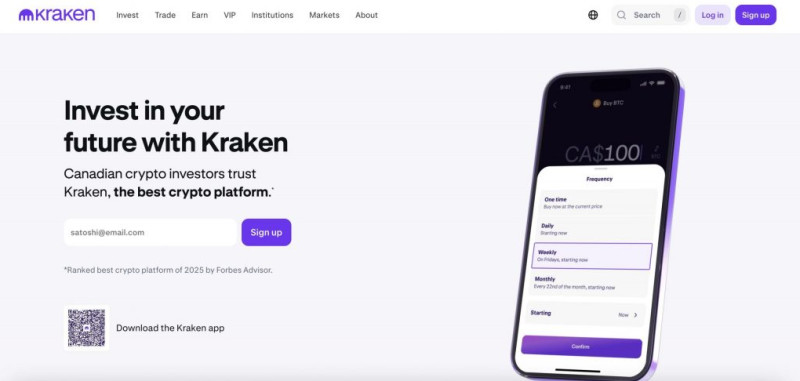
Kraken is positioned as an advanced crypto exchange for users who prioritize liquidity, security, charting, order types, margin, and futures. It launched in 2011 and reports a long security record. One profile states that Kraken has never lost customer funds to a hack.
Reported crypto selections include more than 220 coins and more than 550 coins. The platform offers spot trading, margin trading, futures, leveraged positions, advanced charting, and staking. Kraken publishes regular proof-of-reserves information with Merkle-tree attestations.
Kraken figures differ across sources. One comparison lists 0.16% maker and 0.26% taker fees. Another lists 0.25% maker and 0.40% taker fees, with volume-based discounts. The differing figures should be checked against the relevant interface, region, volume level, and date before use.
Gemini
Gemini is presented as a security- and compliance-focused centralized exchange. Founded in 2014 by the Winklevoss twins and publicly listed, it offers more than 120 supported cryptocurrencies, a $5 minimum deposit, and access in all 50 U.S. states.
Reported security credentials include SOC 2 Type II compliance, cold-storage controls, and insurance for crypto holdings. Reported fees include 0.20% maker and 0.40% taker in one comparison, and a 1.49% transaction fee plus a 1% convenience fee for standard market orders in another.
Gemini has fewer supported assets and fewer features than some larger exchanges. Its convenience and instant-buy fees may be high. It also faced controversy around its Earn program after the collapse of partner Genesis.
Binance.US
Binance.US is the U.S.-regulated branch of Binance and is positioned as a low-cost exchange for active and high-frequency traders. It offers approximately 150 supported coins and a $10 minimum deposit.
The reported fee schedule includes 0% on Bitcoin pairs and 0% maker and 0.10% taker on other assets. This makes Binance.US the lowest-fee option identified in the U.S.-focused comparison. Security measures include cold storage and the SAFU fund.
Reported limitations include fewer fiat deposit options than Coinbase, less responsive customer support, and a smaller listed asset selection than some global platforms. The parent Binance organization has faced regulatory challenges in multiple global jurisdictions.
Bitstamp
Bitstamp is described as one of the oldest continuously operating crypto exchanges, founded in 2011. It is known for regulatory licensing and operational continuity.
Features include around 75 supported cryptocurrencies, a $10 minimum deposit, Bitstamp Pro for professional trading, EU and U.S. licensing, and institutional custody. Fees are listed at 0.25% maker and 0.25% taker, with discounts at higher volumes.
Bitstamp is presented as an option for long-term investors and institutions that value stability, regulation, custody, and compliance over a large altcoin catalog. It is considered more suitable for conservative users than for traders seeking the broadest selection of assets or the lowest possible fees.
Fidelity Crypto
Fidelity is a traditional brokerage that added direct crypto trading, a crypto IRA, and a stablecoin. It is positioned for investors who want crypto alongside stocks, ETFs, mutual funds, and retirement accounts.
Fidelity Crypto supports five reported assets: Bitcoin, Ethereum, Litecoin, Solana, and Fidelity Digital Dollar (FIDD). The reported minimum trade is $1. There is no commission, but a 1% spread on each trade applies.
In January 2026, Fidelity announced FIDD, its own stablecoin backed by cash, cash equivalents, and short-term U.S. Treasuries. Fidelity also launched a Crypto IRA product that allows Bitcoin to be held in a tax-advantaged retirement account.
The five-coin selection is extremely limited compared with dedicated exchanges. Fidelity does not offer DeFi, advanced charting, crypto-backed loans, or broad altcoin features. It is a stock and retirement brokerage first and a crypto platform second.
eToro
eToro is a multiasset investment and social trading platform with CopyTrader, bundled portfolios, and a crypto wallet. It reports more than 38 million users across more than 100 countries.
Its main social feature is CopyTrader, which allows users to replicate the trades of selected investors. Other features include Smart Portfolios, large-cap and growth crypto baskets, stocks and ETFs, and a built-in crypto wallet through the eToro Money app.
Fees include approximately 1% spread and 1% on each crypto buy and sell. A $5 withdrawal fee applies. The U.S. version has fewer crypto assets than the global platform, and one profile states that it does not offer crypto-to-crypto trading pairs.
Uphold
Uphold is a multiasset platform supporting crypto, stocks, precious metals, and forex under one account. It offers more than 200 supported cryptocurrencies and approximately 1% crypto spreads.
Real-time proof of reserves and customer-assets-backed reporting on a 1:1 basis are distinguishing transparency features. Uphold is positioned for investors who want diversification beyond crypto. Its crypto spreads are wider than those of low-fee exchanges such as Binance.US.
SoFi Invest Crypto
SoFi places crypto inside a broader financial-services ecosystem that includes student loans, mortgages, insurance, and stock investing. It offers more than 20 supported cryptocurrencies with an approximately 1.25% spread and a $10 minimum deposit.
SoFi is positioned for finance-first users who want limited crypto exposure without opening a separate exchange account. Limitations include limited coin selection, higher spreads than pure-play crypto exchanges, and no large catalog of advanced crypto tools.
TradeStation Crypto
TradeStation Crypto extends the TradeStation brokerage into cryptocurrency trading. It offers more than 20 supported cryptocurrencies, a $10 minimum deposit, 0.30% maker and 0.30% taker fees, advanced charting, API access, and integration with equities and futures.
TradeStation is aimed at professional or experienced traders who already use TradeStation and want crypto inside an established brokerage infrastructure. The supported crypto catalog is narrower than those of Kraken, Binance.US, or Crypto.com.
Public.com Crypto
Public.com began as a stock-investing platform and added crypto in 2021. It offers more than 30 supported cryptocurrencies, a $1 minimum deposit, and approximately 1% spread.
Features include stocks and crypto in one app, community comments, and trade discussions. Public.com is positioned for casual investors who want a simple way to combine stocks and crypto. Limitations include limited asset range, higher spreads than dedicated low-fee exchanges, and social commentary that can encourage herd behavior.
Crypto.com
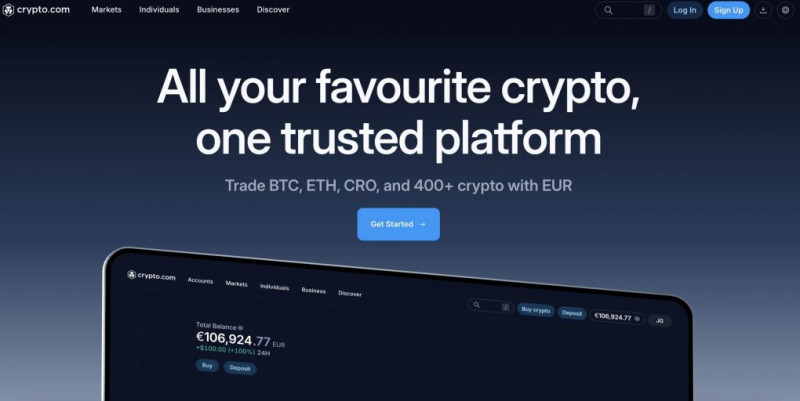
Crypto.com is an all-in-one crypto ecosystem that combines spot and futures trading, staking, savings, cards, DeFi, payments, and rewards. The platform was launched in 2016 and operates in more than 90 countries.
Reported asset counts include more than 300, 400, or 425 cryptocurrencies, depending on the source. The platform supports spot and futures markets, perpetual futures, staking, savings accounts, a self-custodial DeFi wallet, Visa debit and credit cards, and NFT features.
Reported fees differ by interface and source: 0.075% maker and 0.075% taker in one U.S. comparison, 0.25% maker and 0.50% taker in another, and advanced exchange fees of 0.08% to 0.25% for makers and 0.18% to 0.50% for takers in a separate profile. Some fee discounts require holding or staking CRO, which exposes the user to the price volatility of that token.
Card rewards include up to 5% CRO back on a prepaid Visa card and up to 6% CRO back on a Visa Signature credit card. Reported staking rates include up to 18.93% APY depending on the coin. Security measures include ISO 27001 certification, SOC 2 Type II certification, cold storage, and assets insured up to $750 million.
Limitations include fee discounts that depend on CRO staking, CRO volatility, mixed reviews on customer support, and the app feeling crowded for newcomers. The more advanced Crypto.com Exchange is available only to institutions and professional traders.
CoinRabbit: Crypto-Backed Loans
CoinRabbit uses a different model from a conventional crypto exchange. It focuses on crypto-backed loans that allow an investor to obtain liquidity without selling the underlying asset. An investor can deposit BTC, ETH, SOL, or hundreds of other cryptocurrencies as collateral and receive a loan in more than 12 supported currencies or stablecoins.
Features include no credit check, no sell order, funds processed within 10 to 15 minutes, fixed APR beginning at 17%, short-term loans of up to 30 days, and risk-zone notifications. The service states it does not rehypothecate collateral, and deposited crypto is held in cold wallets with multisignature protection.
CoinRabbit also describes a broader product ecosystem that includes a crypto wallet, a crypto exchange, a savings account paying 5% APY on stablecoins, and more than 350 supported cryptocurrencies as collateral. The platform is intended for investors who need liquidity against existing holdings rather than users who want to trade dozens of coins each day.

Crypto Loans Versus Sell Orders and Tax Events
Selling crypto generally creates a taxable disposal. In the United States, short-term capital gains are taxed as ordinary income, while long-term capital-gains rates range from 0% to 20% depending on the taxpayer's bracket.
A crypto-backed loan works differently. The investor deposits crypto as collateral and receives fiat or stablecoins. No sale occurs and no taxable event is created when the collateral is deposited, provided the transaction is treated as a loan rather than a sale or taxable disposition. Tax treatment can vary by jurisdiction and individual circumstances.
Combining Multiple Platforms
One multi-platform arrangement involves using different services for different purposes: hold long-term crypto with a lending platform such as CoinRabbit and borrow against it when liquidity is needed, use Kraken for active crypto trading and deeper order books, and use Fidelity for stocks, ETFs, and retirement accounts.
This arrangement separates custody, trading, lending, and traditional brokerage functions. It also introduces the need to manage security, transfers, tax records, and fees across several platforms.
Alpaca: API Trading and Crypto Wallets
Alpaca provides brokerage and API infrastructure for U.S. stocks, options, and crypto. Its crypto products include wallets, BTC and USDT coin-pair trading, market data, and API access. Alpaca introduced an initial crypto-wallet rollout in July 2022, supporting Bitcoin, Ethereum, Solana, and USDT.
Coin-pair trading allows one crypto asset to be purchased with another crypto asset. Alpaca's initial base currencies were BTC and USDT, alongside USD pairs. The service was available to eligible international participants and in all U.S. jurisdictions except New York at the time described.
Alpaca's disclosure materials identify risks specific to automated systems including connectivity failures, power loss, computer crashes, system errors, errant orders, market-data problems, flash crashes, cybersecurity failures, and permanent loss of value. Alpaca Crypto is a FinCEN-registered money services business but is not a member of SIPC or FINRA.
Base App: Social, Trading, Payments
The Base App is an everything app that combines social features, trading, payments, app discovery, and earning. The announcement stated that it was available in more than 140 countries. The app is built around the idea that protocols, applications, creators, posts, and other assets can be tokenized and traded in an open market.
The "For You" feed is built on open protocols such as Zora and Farcaster. Users can discover creators, find trending tokens, browse viral content, copy trades, set preset quick-buy amounts, and trade Bitcoin, Solana tokens, tokenized equities, and perpetual futures.
Earning features include a share of transaction fees when people trade a user's content, encrypted direct messages, portfolio-management tools through AI agents, games that reward users, DeFi applications for staking and lending, and up to 3.35% APY for holding USDC in the app. A limited-time USDC rewards program was offered from the launch through December 21.
Moonshot: Solana Meme-Coin Trading
Moonshot is an iOS app designed to make Solana meme-coin trading accessible through a mobile interface and familiar payment methods. It is described as the first iOS app available through the App Store that lets users purchase and trade Solana meme coins using Apple Pay.
Key features include sign-up by email, Face ID authentication, no seed phrase required for initial use, Apple Pay integration, curated Solana meme coins, real-time charts, and transfers to friends through usernames rather than wallet addresses. The app lists Bonk, WOOF, POPCAT, and Billy among its curated assets.
The setup process involves downloading the app, signing up with email, setting up Face ID, verifying the email address, and accessing the app. The reported setup time is less than one minute. A personal account test described in the source involved an attempted Bonk purchase with Apple Pay that failed, possibly because of the account's payment configuration. The user switched to a debit card, which required card verification and a small deposit.
Moonshot is designed to make the app easier for newcomers while preserving an option to export a seed phrase. Users can send coins to friends using usernames rather than wallet addresses. The app also includes a referral program that pays 50% of referred users' trading fees. The source cautions that crypto is risky and that the product experience does not remove the volatility or potential loss associated with meme coins.
Blum: Hybrid Exchange for Emerging Markets
Blum describes itself as a hybrid exchange for emerging markets. Its platform combines an offchain order book with onchain settlement. Users can choose between self-custody and MPC custody options.
Blum supports more than 30 chains including Ethereum, Solana, Binance Smart Chain, and Ton. Its reported features include universal token access, mobile-first trading through Telegram, gamified trading mechanics, simplified perpetual futures, options, futures on NFTs, pre-market token derivatives, P2P fiat trading, and cross-network trading.
The platform's marketing states that meme coins have attracted 40% of Millennials and Gen Z because of their humor and community identity. It also cites a figure of 55% of Gen Z investors investing in crypto. The platform's own presentation does not provide a detailed fee schedule, custody audit, insurance terms, or proof-of-reserves figures in the captured material.
BISON: Coin Listings and Security Resources
BISON is powered by the Börse Stuttgart Group. Its app-focused material includes new coin listings, savings and staking features, banking partnerships, tax-reporting tools, and scam-awareness resources.
BISON announced adding seven additional cryptocurrencies for trading. Another update announced 16 newly listed coins including SUI, ATOM, LRC, IMX, 1INCH, CVX, CRO, ANKR, BNT, CVC, GNO, NMR, and STORJ. A separate update added six coins including Avalanche, Binance Coin, Lido DAO, and NEAR.
BISON and Blockpit offer a crypto tax-reporting workflow. BISON published an overview of DAC8, which introduced new reporting and tax obligations for cryptocurrencies from 2026. Deutsche Bank became an additional banking partner for BISON. The app reports an overall rating of 4.49 out of 5 based on 48,180 total reviews.
Bitcoin-Only and Simple Payment Apps
Swan is designed for investors who want to accumulate Bitcoin through recurring purchases. It charges a 0.99% fee for recurring purchases with a $10 minimum deposit. Cold-storage custody is handled by BitGo. Swan does not offer altcoins, staking, or advanced trading.
Cash App is owned by Block, Inc. and integrates Bitcoin purchasing with peer-to-peer payments. It has an approximately 1.75% average spread and a $1 minimum deposit. PayPal integrates cryptocurrency trading into its payments network with a 1.5% spread on most trades and supports BTC, ETH, LTC, BCH, and PYUSD.
Security Checks for Crypto Apps
A platform's safety profile should be evaluated through several layers. Regulatory status matters, but it does not eliminate market, custody, cybersecurity, or counterparty risk. Long-established, regulated U.S. centralized exchanges are generally presented as safer entry points than new or unlicensed apps.
Investors should distinguish between a platform claiming customer assets are fully backed, a third-party reserve report, a Merkle-tree proof of reserves, a full financial audit, an insurance policy, cold storage, and a government-backed guarantee. Kraken publishes reserve attestations, Uphold reports real-time reserves, and Crypto.com states it has regular audits.
Cold storage, multisignature controls, MPC, and self-custody can reduce the risk that private keys are exposed online. FDIC coverage applies to eligible U.S. dollar balances and does not protect crypto price declines or crypto held in a platform account. A platform's history of hacks, outages, delayed withdrawals, regulatory fines, inaccurate disclosures, or customer-support failures is relevant to the comparison.
Security Features to Verify
- Two-factor authentication and passkeys for account access
- Cold storage and multisignature controls for asset protection
- Proof-of-reserves reports or audits published by the platform
- History of hacks, outages, or lost customer funds
- FDIC insurance on cash balances and crypto insurance policies
- Withdrawal options to external wallets
- Regulatory status and reporting requirements
- Custodial, self-custodial, or hybrid model used
Tax Recordkeeping for Crypto App Traders
Buying crypto on an exchange does not generally create an immediate tax obligation in the same way as selling an asset for a profit. The purchase date and fair market value should still be recorded. Users should retain purchase date, purchase time, coin and quantity, U.S. dollar fair market value at acquisition, exchange or app used, fees paid, withdrawal and deposit records, transfers between exchanges and wallets, disposal dates, proceeds, cost basis, capital-gains records, loan collateral and loan proceeds, staking rewards, and stablecoin transactions.
Trading or selling crypto for a profit may create a capital-gains event. The tax result can depend on the holding period, jurisdiction, income bracket, and transaction type. There are typically no tax consequences merely from transferring crypto between an exchange account and a self-custodial wallet, although records should still be retained.
A crypto-backed loan may avoid an immediate taxable sale when the transaction is treated as collateralization rather than disposal. Interest, loan fees, collateral value, and later repayment or liquidation can create different tax questions. The tax treatment should be confirmed for the relevant jurisdiction. CoinTracker's Portfolio Tracker can record activity across exchanges and wallets, with features including unified transaction history, automatic cost-basis tracking, capital-gains summaries, wallet-balance tracking, return tracking, and multi-exchange and multiwallet support. The source states that CoinTracker has more than three million users.
Platform Comparison Summary
- Coinbase: beginner-friendly, regulated, more than 250 coins, higher fees for active traders
- Kraken: advanced exchange, more than 550 coins, strong security record, complex for beginners
- Gemini: security-focused, 120+ coins, SOC 2 compliance, fewer features than larger exchanges
- Binance.US: lowest U.S. fees, 150 coins, regulatory challenges at parent level
- Robinhood: simple interface, limited coins, embedded costs in spreads, regulatory history
- Crypto.com: all-in-one ecosystem, 300+ coins, CRO staking rewards, crowded interface
A large catalog does not by itself establish liquidity, custody quality, or ease of use. Some services list hundreds of assets while others focus on a smaller number of major coins.
When you look for a crypto coin trading app, there is no single best choice for everyone. A beginner who wants simplicity may prefer Coinbase or Robinhood. An advanced trader may need Kraken or Binance.US. Someone who wants social features may choose eToro. A person who already uses SoFi or Fidelity for other investments may keep crypto in the same app for convenience.
The best crypto coin app for you depends on your trading style, your coin needs, your risk tolerance, and how much control you want over your assets. Check fees beyond the headline rate. Look at the full cost including spreads, routing, withdrawals, and network fees. Verify security measures including custody model, proof of reserves, and insurance scope. Test the interface before committing real money.
One practical approach is to start small with an app that matches your main use case. If you want to trade actively, pick a platform with deep order books and low fees. If you want to hold long-term, prioritize security and custody. If you need liquidity without selling, consider a crypto-backed loan platform like CoinRabbit. You can also split your exposure across multiple apps, each handling a different function.
The crypto coin exchange app market is mature enough that you can find a fit for almost any preference. The key is to compare honestly, watch for hidden costs, and keep your security practices tight. Whether you use a simple payment app or a full-featured exchange, understand what you own and where your assets sit.
The total cost therefore depends on the routing method, trade size, order type, and market conditions. A zero-commission headline does not reveal the bid-ask spread or other costs embedded in execution.
If you are new to crypto, start with an app that offers clear fees, simple onboarding, and solid security. If you are experienced, look for deep order books, advanced order types, API access, and responsive support. The crypto trade apps you choose shape your experience more than the coins you pick.
The cryptocurrencies on robinhood selection is limited compared with dedicated exchanges, but the platform may suit users who already trade stocks there. The kraken vs binance us comparison comes down to fees, coin access, and whether you need advanced features like margin or futures. The best application for trading crypto is the one that matches your actual habits, not the one with the most features or the lowest headline price.
Comments on “How to Compare Crypto Coin Trading Apps Like Robinhood: Fees and Security”
No comments yet. Be the first to share your thoughts.