How to Pick Your First Crypto Trading Bot for Beginners
What a crypto trading bot for beginners is
A crypto trading bot for beginners is just software that does trades for you on crypto exchanges. It follows rules you set, and it can automatically buy and sell crypto without you watching the screen. I like to think of it as a helper that never sleeps. The main point is not to remove risk, because nobody can do that, but to make it easier to test and learn.
When you are new, it is easy to make choices based on fear or hype. A bot takes that away since it just runs the code. You still need to understand what the bot does before you trust it with real money. Start small and use demo funds to see how it works.
The goal is not to eliminate market risk - who can - is to make it easier to test, control, and evaluate a strategy before real money is at stake.
Why bots appeal to new traders
I get why a lot of folks new to crypto like the idea of a bot. It removes some of the stress that comes with manual trades. You do not need to stare at charts all day, and the bot can act when you are asleep or at work.
Reasons bots help newcomers
- Emotion-free trading - bots follow code, not fear or greed.
- Round-the-clock monitoring - markets never sleep, bots react when you are offline.
- Learning tool - backtesting and demo modes show how a strategy behaves on old data.
- Structured execution - turns a simple idea into repeated actions without manual clicks.
Bots follow code, not fear or greed.
How to choose your first bot
Your first bot should be easy to understand, test, and control. Do not pick the one that promises the highest return on paper, because those often hide complex stuff. A good beginner bot lets you watch a full cycle, from open to close, without you restarting it each time.
Personally, if you are looking for the best crypto bots for beginners , focus on simple logic and demo mode. I would rather use a plain bot that I understand than a fancy one that confuses me. The best auto crypto trading app for me is one that shows each step clearly.
Questions to answer before you start
Before you link any API key, sit down and answer a few plain questions. If you cannot answer them with ease, that is a sign to stay in demo mode longer. I keep a notebook for this, it helps.
Questions a beginner should answer
- What market condition am I trading? Ranging, trending, or volatile.
- Do I understand how the bot enters and exits? Unclear logic makes results hard to judge.
- How much capital am I ready to risk? Position size drives drawdown and stress.
- Can I test the setup first? Demo trading shows behavior without real exposure.
- When would I stop or adjust the bot? Even automated trades need risk controls.
If you cannot comfortably answer these, the safest move is not to avoid bots entirely but to start with a simpler bot in demo mode and learn how automated execution behaves.
Some bots I looked at
There are many tools out there, and the best platforms for crypto day trading often include bot support. I made a short list from the data I found, with prices and what they do best for new folks. None of this is financial advice, just info to compare.
Bots worth a look for newcomers
- Bitsgap LOOP Bot - simple repeatable cycle, demo mode, starts at $29 per month with 7-day free trial, supports 17 plus exchanges.
- Pionex free built-in bots - 16 free bots like GRID and DCA, low 0.05 percent fee, 370 plus pairs, native AI helper.
- Cryptohopper - copy-trade from top performers, strategy market, $19 to $99 per month, 9 plus exchanges.
- 3Commas - SmartTrade terminal with AI suggestions, free limited plan, pro $49 per month, 20 plus exchanges.
- TradeSanta - cloud bots, quick setup, free tier, paid from $15 per month, pre-set strategies.
- Coinrule - rule-based automation, no coding, free plan, paid from $29 per month.
- Telegram bots like Bonkbot and Trojan - start with just a wallet address, free to use, exchange fees apply.
Why a LOOP bot can be a good first pick
Bitsgap's LOOP Bot is built around repeated cycles. It opens a position, aims to close at profit, then starts the next one on its own. I find this clear because you see the whole loop instead of one random trade.
The logic is transparent, which helps a beginner see how automation works. You are not blindsided by a single trade result. That is why many guides point to LOOP as a strong first choice for a crypto trading bot for beginners.
The logic is transparent, which helps a beginner see how automation works rather than being blindsided by a single trade result.
Types of bots and which fit new folks
Not every bot is made equal. Some fit sideways markets, some fit dips, some are more advanced. For a first bot, LOOP usually scores high because it teaches automation without steep learning.
Common bot types
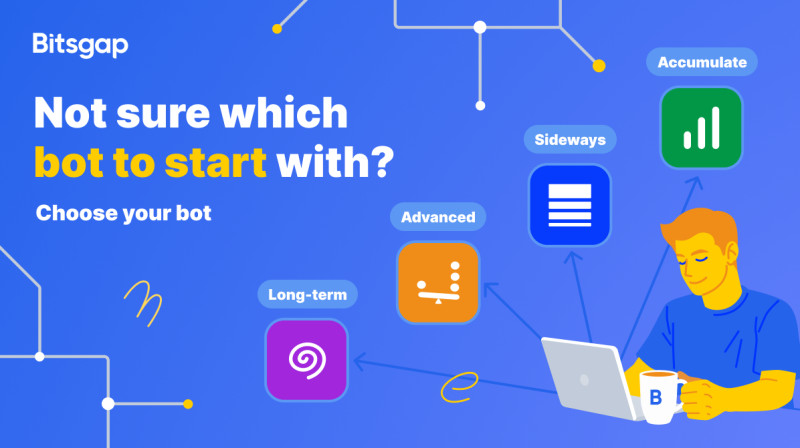
- LOOP Bot - best for ongoing automation and observing full cycles.
- GRID Bot - ideal for sideways markets, makes ladder of buy and sell orders in a range.
- DCA Bot - buys fixed amounts at regular intervals, smooths volatility.
- COMBO Bot - more advanced, often includes futures logic, higher complexity.
- BTD Bot - tries to catch rebounds after a price drop.
- QFL Bot - setups from base levels, more advanced market reading.
Setting up your first bot in five steps
Getting started is not hard if you take it slow. I suggest you follow a simple path and not skip demo mode. Here is a plain setup flow.
First bot setup steps
- Choose a liquid pair - less slippage, cleaner execution.
- Start with demo mode - verify bot behavior before real funds.
- Pick a simple first bot like LOOP - focus on learning automation.
- Use small capital when going live - limits emotional pressure.
- Watch one full cycle before tweaking - get enough data to judge.
What to check before you go live
Before you press start with real money, run through a checklist. I cannot stress this enough: know your settings. A quick review saves pain later.
Things to check before launch
- Bot logic - know how it enters, exits, and repeats.
- Market condition match - bot should fit the real market, not a hoped one.
- Pair liquidity - low liquidity assets can be unpredictable.
- Investment size - avoid overexposure, keep risk modest.
- Take-profit logic - profits must be defined before trade starts.
- Risk settings - define what happens if price moves against bot.
- Demo result - testing reveals weak settings before real capital.
- Review plan - know when to continue, adjust, or stop.
Common beginner mistakes
I have seen many new traders trip on the same stones. The good news is they are easy to avoid if you know them. Keep your first experience slow and structured.
Mistakes to avoid
- Choosing the most complex bot first - complexity obscures results.
- Starting with too many bots - makes performance evaluation impossible.
- Using too much capital immediately - small moves create outsized stress.
- Ignoring demo trading - turning real money into a learning tool is expensive.
- Picking a volatile low-liquidity pair - hard to control and costly.
- Changing settings too early - interrupts strategy before full cycle.
- Judging the bot after one trade - one trade proves nothing.
- Looking only at bot profit - portfolio value, open positions, fees also matter.
A better first experience is slower and more structured: one bot, one pair, one test, one full cycle, and only then a decision about scaling.
Keeping your bot and keys safe
Security is not glamorous but it matters a lot. When you connect a bot to an exchange, you give it API keys. Treat those like your house key.
Security best practices
- API keys - use read-only or trade-only keys, enable IP whitelisting and 2FA on exchange.
- Backup authentication - keep secure backup of 2FA tokens and recovery codes.
- Demo before live - reduce risk of costly rookie errors.
- Risk controls - set stop-loss, take-profit, position-size limits inside bot.
- Regular monitoring - even automated bots need oversight during high volatility.
How to measure bot performance
You need real numbers to know if a bot helps you. Do not just look at one trade. Look at the whole picture over time.
Metrics to evaluate
- Profit figures - platforms like Bitsgap report large user profit totals and average returns depending on settings.
- Launch volume - over 4.7 million bots launched on some platforms shows usage scale.
- Exchange coverage - most support 15 to 20 plus exchanges, some cover 370 plus pairs natively.
- Backtesting - test strategies on historical data with realistic slippage and fees.
- Uptime and reliability - aim for 99.9 percent or higher published stats.
Rules and taxes you should know
Using a bot is legal in most places, but you still have duties. I am not a lawyer, just flagging what the source says. Keep records.
Legal and tax notes
- Compliance - automated trading permitted, but some jurisdictions require licensing or reporting.
- Market-manipulation rules - bots for spoofing or wash-trading violate regulations.
- Transparency - if bot activity affects market volume, disclose where required.
- Tax reporting - gains from bot trades are typically taxable; keep accurate records.
Telegram bots for simple start
If you want a very simple start, Telegram bots are interesting. Bonkbot launched in November 2023 on Solana, powered by Jupiter DEX. Trojan, formerly Unibot Solana, launched in May 2023. Both are free; exchange fees apply.
Two Telegram bots
- Bonkbot - community focus, referral program, supports $BONK token buy-and-burn, easy interface, but no limit orders or DCA.
- Trojan - has DCA, limit orders, copy-trading, PNL sharing, over 100k users, 1.5 billion total volume, but advanced features can intimidate.
- Both free to use - trading fees charged by underlying exchange, not the bot.
- For absolute beginner - Bonkbot often recommended for clean UI; Trojan if you want more order types.
When picking a pair, avoid weird thin markets. I would stay away from crypto under a penny as a first test because those can be hard to control and expensive to trade. Also, if you plan on buying and selling crypto on the same day , make sure the bot supports quick exits and the pair has liquidity.
Where AI fits in bot trading
AI is showing up more in this space. The phrase crypto trading with ai is not just hype; some bots now use language models to read sentiment from social posts and news. This can help with short term trade crypto decisions, but still needs your oversight.
We also see cross-chain execution that enables cryptocurrency arbitrage trading across blockchains and layer-2 networks. Regulatory-aware bots with built-in tax reports are becoming common. And you can describe a goal like preserve capital and let AI design a strategy. I think that is neat but keep it simple at first.
A simple plan to start small
If you ever told yourself teach me cryptocurrency , a bot in demo mode is a cheap teacher. Use the best auto crypto trading app that you understand, not the flashiest. The key is to learn by watching cycles.
My starter plan
- Pick a bot based on ease of use, cost, and customization needs.
- Start small with demo mode or tiny investment to test.
- Monitor performance, especially during volatility.
- Utilize backtesting to refine on historic data before real money.
Comments on “How to Pick Your First Crypto Trading Bot for Beginners”
No comments yet. Be the first to share your thoughts.