
Nutrient Film Technique: How to Build an NFT Hydroponic System
What the Nutrient Film Technique Is
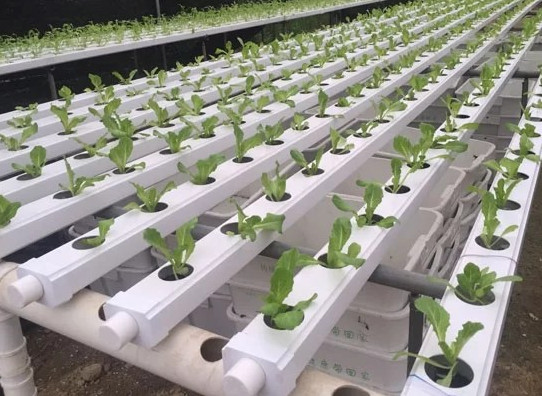
The nutrient film technique, or NFT, is a recirculating hydroponic method where a thin stream of nutrient-rich water flows through sloped channels. Plants sit in net cups along the channel, their lower roots dipping into the flowing solution while the upper roots stay exposed to air. No soil, no heavy growing medium. Just water, nutrients, and gravity doing the work.
Dr. Allen Cooper developed this in the 1960s. It caught on for both indoor gardening and commercial growing because it uses a small solution volume while delivering nutrients and oxygen continuously. You can run it horizontally or vertically, in a small apartment, a greenhouse, or a big facility. It works best for shallow crops like lettuce, herbs, and microgreens.
THE ONLY DIFFERENCE: IN NFT, THE NUTRIENT-LADEN SOLUTION FLOWS CONTINUOUSLY OVER THE PLANT'S ROOTS. YOU ACCOMPLISH THIS STEP WITH THE HELP OF GRAVITY.
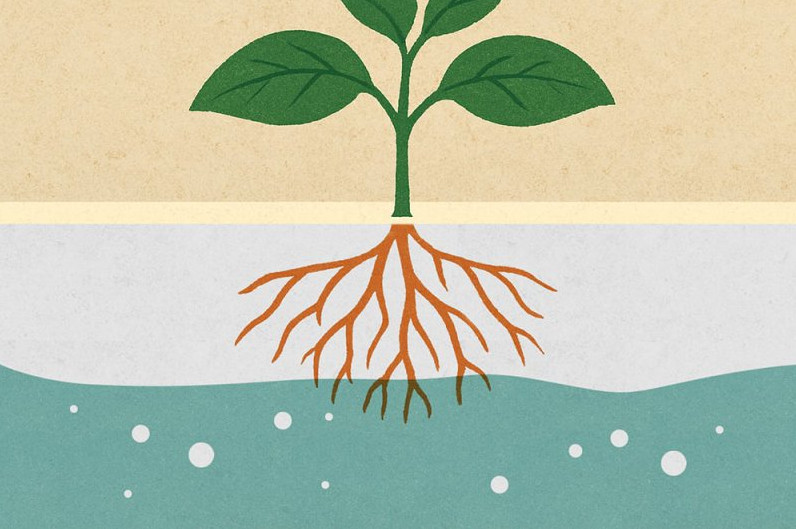
A typical nutrient film is only about 2-3 mm thick. It moves from the upper end of a channel to the lower end, drains back into the reservoir, and starts the loop again. The lower roots stay wetted, the upper roots grab oxygen from the air. Roots aren't fully submerged like in Deep Water Culture. This mix of water, nutrients, and air supports active uptake and root development. Moving water also limits stagnant conditions that can encourage anaerobic bacteria and root rot.

NFT Root Zone Conditions
NFT aims to provide aerobic nutrition - roots get nutrients and oxygen at the same time. The upper root zone sits in air, the lower roots get water and dissolved nutrients. The flow keeps the film moving and can mix dissolved oxygen into the solution.
Some descriptions call this superior oxygenation because most roots remain in air rather than submerged. Another view notes that flow-related oxygenation can be limited, and root health still depends on flow rate, temperature, cleanliness, and how much root mass is actually exposed. Both views have merit: atmospheric root exposure defines NFT, but it doesn't remove the need to monitor oxygen and solution conditions.
The difference shows up clearly when you compare NFT with Deep Water Culture. In DWC, roots hang in a nutrient reservoir like plants in a lake. In NFT, most roots sit in air with a shallow river of nutrient solution flowing past. Exposed roots also make it easier to inspect color, growth, clogging, and disease symptoms than roots hidden in opaque media or a deep reservoir.
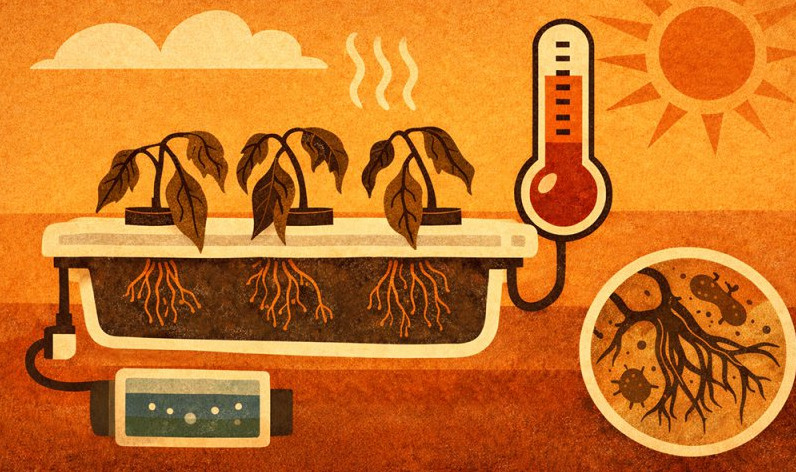
Warm solution reduces dissolved oxygen. Above roughly 75°F or 24°C, oxygen availability drops and root disease becomes more likely. Very cold temperatures can also slow nutrient availability and root activity. A continuous NFT design should combine root exposure with temperature monitoring and adequate circulation.
The NFT Circulation Cycle
An NFT system runs as a closed recirculation loop with three main stages. First, a submerged pump draws nutrient solution from the reservoir and sends it through tubing to the highest point of the first growing channel. In automated setups, EC and pH monitoring can check mineral concentration and acidity while the system runs. The pump must match the vertical height and required channel flow. A reservoir below the channels lets gravity return the solution.
Second, the channels sit at a slight incline. The solution travels downward as a shallow film, passing plant roots so they can absorb water and nutrients. A manifold can split flow among several channels when one pump serves a multi-channel install. Flow must be fast enough to keep the channel supplied and prevent stagnation, but not so fast that water moves past roots too quickly. Turbulent or excessive velocity disturbs the film; too-slow flow starves roots of nutrients and oxygen.
Third, solution reaching the end of a channel enters a return line and flows back to the reservoir. The same water gets pumped through again rather than discarded. An air stone and air pump may oxygenate the reservoir, while falling water and splashes at the return point also introduce air.
THE NUTRIENT SOLUTION DRAINS BACK INTO THE RESERVOIR TANK, WHERE AN AIR STONE OXYGENATES THE RESERVOIR WATER.
The closed loop saves water and nutrients, but it can also recirculate pathogens. Sanitation, root inspection, and rapid response to flow or disease problems matter a lot.
Core NFT System Components
Essential parts for a functional NFT system
- One or more sloped grow channels or troughs
- A reservoir containing nutrient solution
- A pump that continuously or intermittently circulates the solution
- Net cups or plant holders installed along the channels
- A small amount of seedling-growing medium
- A return collection system that carries solution back to the reservoir
- Tubing and sealed connections
- pH, EC or TDS, and temperature monitoring equipment
- A reliable way to inspect flow, roots, plants, and reservoir level
The basic components are physically simple, but their sizing and alignment determine whether nutrients and oxygen reach every plant evenly.
Grow Channels: Materials and Dimensions
NFT channels are usually shallow so the system uses little water and root space. Published dimensions include channels or troughs about 1-3 inches deep, food-grade PVC pipe around 3-4 inches diameter for smaller DIY builds, larger UV-resistant commercial channels, fiberglass or specialized commercial troughs, UPVC or white vinyl pipe for DIY, and vinyl downspouts for simple home systems.
Food-grade PVC is cheap, available at hardware stores, and easy to modify with a drill and hole saw. Commercial channels are lighter and more optimized when made from UV-resistant plastic. Their contoured designs can improve distribution and reduce debris buildup. Fiberglass and purpose-built troughs are options for larger installs.
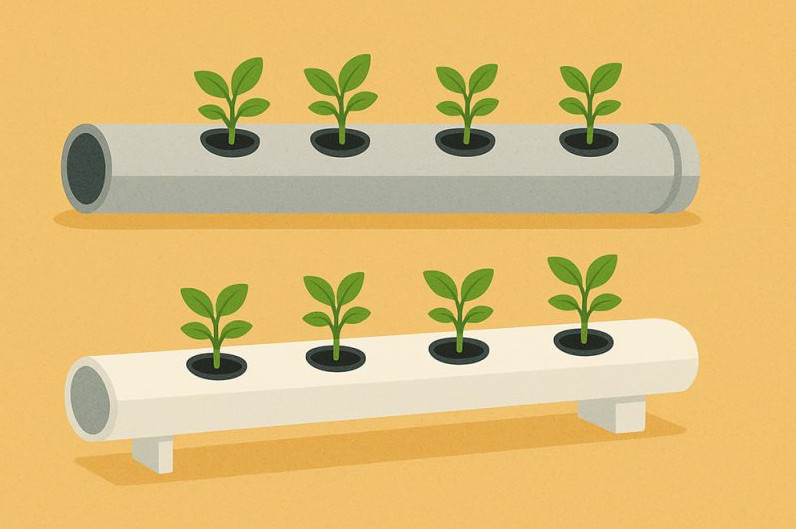
PVC and fittings contacting the nutrient solution should be suitable for food or drinking water. Solvent cement or waterproof sealant must also be safe for the intended use. One PVC guide suggests letting pipe cement cure about 24 hours before filling the system. For a downspout build, white pipe is preferred. If black pipe is used, painting it white helps keep the internal water and root zone cooler - black pipes heat faster in sunlight.
Channel Slope and Length
Published slope recommendations vary. One general design section suggests 1:100. Another gives a preferred range of 1:30 to 1:40. A maintenance section calls for at least 2% slope in horizontal channels. A technical overview gives an initial range of 1:30 to 1:10 and later describes an industry-standard range of 1:30 to 1:100. A simple downspout example uses a decline of 0.5 inches over 10 feet. The purpose is the same: use gravity to maintain continuous flow without excessive velocity, pooling, or an uneven film. Ranges differ by channel design, crop, flow rate, and whether it's continuous NFT or a hybrid NFT and ebb-flow system.
Channel-length recommendations also conflict. One build guide says no more than 10-12 feet so the far end doesn't get insufficient nutrient supply. Another says experienced growers commonly limit channels to 30-40 feet and recommends shorter channels in series for large areas. A 20-foot downspout install works for home. A general design rule warns that extremely long channels create a large nutrient gradient - plants near the inlet get abundant supply, plants at the far end get the least.
As channels get longer, upstream plants can remove a disproportionate share of key nutrients before solution reaches downstream plants. The problem may show only as lower yields, uneven maturity, or stunting at the far end rather than obvious flow failure.
Channel Spacing and Plant Access
A general planning guide recommends roughly 8-12 inches between channels. Actual spacing depends on mature plant width, plant height, harvest access, and rack construction. Compact crops fit closer; tall or spreading plants need more room. Planned channels should leave space for maintenance, inspection, and harvesting. The support structure must be level side to side while allowing the intended slope along each channel. A rack can be designed for additional channels and higher loads later, but initial capacity should account for the weight of pipes, water, plants, roots, and growing medium.

Reservoir Design and Sizing
The reservoir stores the nutrient solution and supplies it to the channels. It also buffers the system against rapid changes in nutrient concentration and temperature. A larger reservoir generally provides more thermal stability than a small one.
Published sizing guidance includes at least 10 gallons for a small system, roughly 0.5-1 gallon of reservoir capacity per foot of total channel length, a 25-30 gallon tote for a larger downspout example, and a 50-100 gallon reservoir for 100 feet of total channel in a more commercial calculation. The 0.5-1 gallon-per-foot calc aims to provide enough solution for stable temperature and concentration levels.
The reservoir should be food-grade or otherwise safe for the solution, large enough for the system and expansion, opaque or black to limit light and algae growth, sealed against contamination where possible, positioned below the lowest channel or return point, and equipped with a lid or fitted foam or plastic plate for tubes to pass through. It shouldn't be so shallow that water levels change rapidly between watering cycles. In cold conditions, a heating element can be used when necessary, but temperature should stay within the crop's suitable range.
Pumps, Flow Rates, and Return Lines
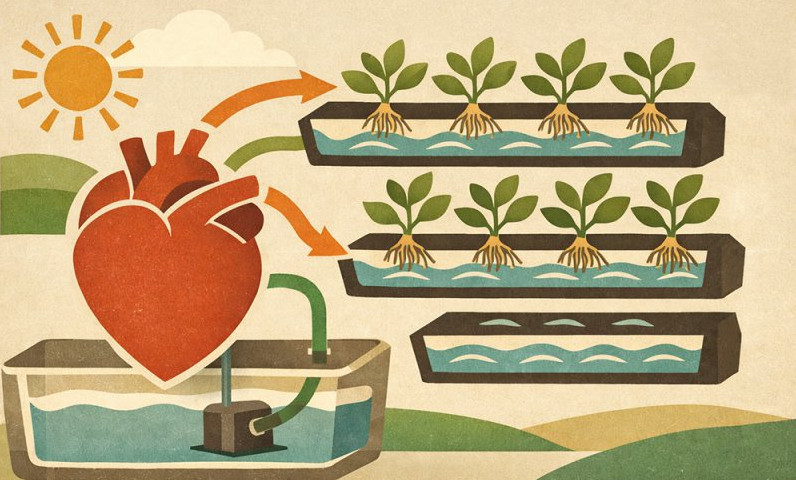
The pump is the heart of an NFT system because it creates the continuous circulation the method depends on. Residential and small commercial systems commonly use submersible pumps rated around 250-400 gallons per hour. The pump must lift solution to the highest inlet and supply required flow to every channel. A pump rated for horizontal reservoir movement may not have enough head to send solution several feet vertically into a rack. Vertical height, tubing length, fittings, and number of elevated channels all affect pump selection.
Published flow-rate guidance includes 1-2 liters per minute per channel for normal systems, roughly 3-5 gallons per hour per channel in another spec, about 0.5 liter per minute as a beginner starting point, and enough flow to wet the lower root zone without flooding mature root systems. These figures use different units and system assumptions, so they're not interchangeable specs. Flow should be evaluated at the last channel, where reduced pressure or uneven manifold flow can leave downstream plants underfed.
If one pump feeds multiple channels, a manifold can distribute solution evenly. Every channel should be checked for the same steady film rather than assuming equal flow from equal fittings. The return line should carry solution back to the lowest reservoir point by gravity, be sized so roots and debris don't obstruct the drain, be sealed against leaks, be positioned so the reservoir stays covered from light, and include a visible section or another way to inspect flow. A blocked return can stop the system as effectively as a failed pump.
One DIY design recommends narrower tubing from the pump to the first channel than between and out of channels. This doesn't guarantee flood prevention but can reduce volume entering the first pipe and help limit overflow while a pump starts, stops, or runs intermittently. Inlet and outlet holes should match hose sizes closely. A slightly adjustable hose position helps regulate water level inside a pipe, especially in a hybrid NFT and ebb-flow install.
Net Cups, Plant Holders, and Growing Media
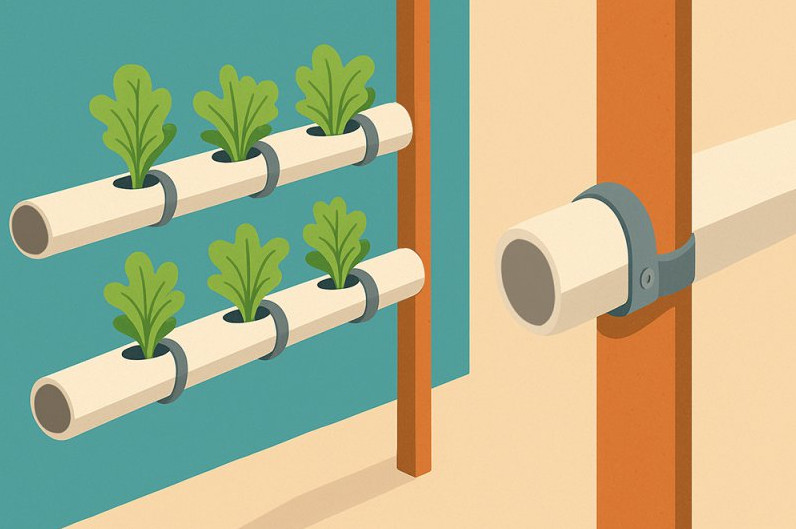
Plants sit in slotted net cups or net pots so roots can extend into the nutrient film. Common cup sizes are 2 inches and 3 inches diameter. A 2-inch cup with a rim slightly larger than the drilled opening works in the downspout design. The cup should fit securely without falling into the channel. Since net cups are usually wider at the top than bottom, a matching hole holds most of the cup inside the pipe while leaving the bottom exposed to the channel.

NFT needs little growing medium after transplant because roots get most water and nutrition from the circulating solution. Medium mainly starts seeds, supports the plant, and reduces disturbance during transplanting. Suitable examples include rockwool cubes, expanded clay pellets, coconut coir, foam or sponge starter cubes, compressed peat or coir plugs, and a small amount of clay pellets around a seedling plug. The medium should be relatively inert and not significantly alter the nutrient solution.
One transplant method places the seedling and starter medium together, then fills the space around it with clay pellets so the root plug stays supported and can absorb nutrient solution.
Net Cup Sizing and Seedling Transfer
A detailed DIY example used a 90 mm (3.5-inch) pipe with net cups roughly 65-68 mm (2.7 inches) tall. The example placed seven cups per meter (39 inches) but noted fewer cups might have given better spacing for the intended compact plants. Cup distance should account for mature plant width, not just seedling size. Broad, short crops may need more horizontal space than narrow or upright crops. Pipe end caps, elbows, and muffles also occupy space, so measure their positions before laying out planting holes.
A seedling is ready for NFT when its roots are long enough to pass through the growing medium and net cup and reach the nutrient solution. White roots should visibly extend from the starter plug. The plant should be positioned so root tips make immediate contact with the nutrient film or retained solution. A seedling too high in the cup may stay dry; one placed too low may get too much solution.
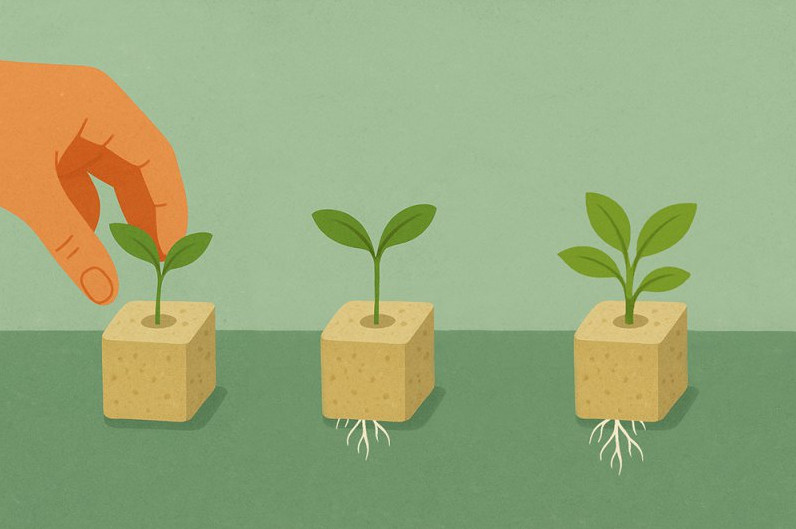
Most NFT channels aren't suitable for direct seed germination because the film at the bottom is too shallow to keep the seed bed consistently moist. Seeds should be propagated separately in rockwool, foam, sponge, coir, peat, or another suitable starter medium and transplanted after roots develop. Spacing depends on mature size - one guide suggests roughly 6-8 inches for lettuce. The downspout build uses holes every 6 inches; the PVC rack example used roughly seven positions per meter and suggested fewer could work for the crop.
Nutrient Solution, pH, EC, and Temperature
NFT plants need a complete hydroponic nutrient formulation with required macro- and micronutrients. Two-part fertilizer systems offer more control over nutrient ratios as plants mature. One component list names manganese, iron, sulfur, magnesium, calcium, phosphorus, potassium, nitrogen, zinc, nickel, chlorine, and boron. Other guidance simply calls for a complete hydroponic formula rather than a universal element list, since crop requirements and fertilizer formulations vary.
pH and Electrical Conductivity
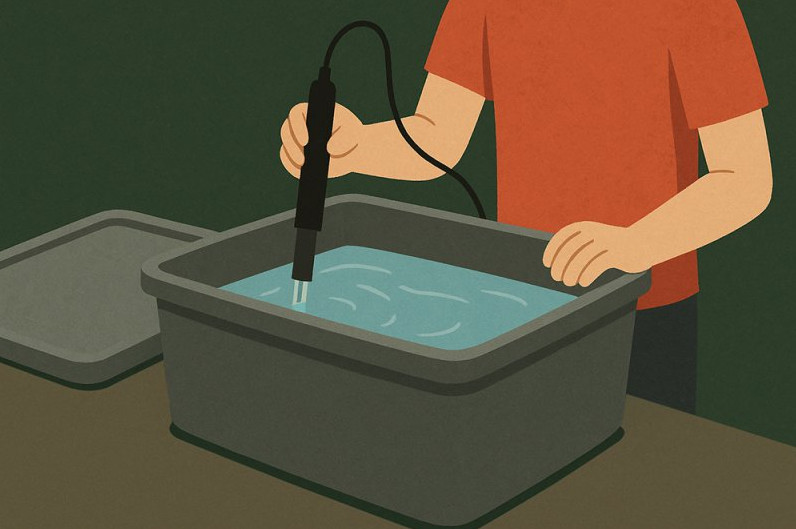
Most NFT guidance targets pH between roughly 5.5 and 6.5. A later maintenance passage gives a slightly narrower common range of 5.5-6.2. The distinction reflects general plant and monitoring ranges rather than a resolution of the difference. pH affects nutrient availability - a drift outside the target range can contribute to nutrient lockout and deficiencies even when the reservoir contains complete fertilizer. pH should be measured at least twice weekly and more often after major changes in plant load, evaporation, fertilizer additions, or water replacement. A reliable pH meter or inline sensor follows the value in real time. pH Down or pH Up solutions make measured corrections.
Electrical conductivity (EC) estimates dissolved nutrient concentration. Common guidance gives roughly 1.0-2.0 mS/cm for NFT, depending on crop and growth stage. A rising EC can indicate water evaporating faster than replacement or nutrients added without proportional water increase. A falling EC can indicate nutrient uptake, depleted fertilizer, or dilution. Crop-specific values and the EC-TDS relationship should be established before filling a system. TDS meters serve as a practical alternative or companion to EC meters in DIY systems.
Solution Temperature and Dissolved Oxygen
The most commonly cited temperature range is 65-75°F (18-24°C). Nutrient availability, dissolved oxygen, and root-disease risk all depend on solution temperature. Warmer water holds less oxygen and can encourage root disease; cold conditions slow root activity and nutrient use. Temperature sensors monitor the reservoir. In one cold-climate indoor NFT install, the grower kept the growing room above roughly 55°F (13°C) with a heater in the water. Lettuce remained acceptable, though daytime temps sometimes exceeded 60°F (15°C).
Advanced operations can monitor dissolved oxygen to assess aeration and circulation. Adequate oxygen supports vigorous roots and limits anaerobic pathogens. A typical target for advanced NFT monitoring is roughly 6-8 mg/L. Dissolved-oxygen monitoring helps identify inadequate aeration, excessive temperature, poor flow, or reservoir problems. Airstones, air pumps, water falls, and exposed upper roots contribute oxygen, but the importance of each depends on temperature, solution volume, plant density, and system geometry.
Monitoring Schedule
Daily checks
- Flow at beginning, middle, and end of every channel
- Reservoir level and pump submersion
- Pump noise or visible signs of blockage
- Nutrient solution temperature
- Plant stress, wilt, pests, and discoloration
- Wet or dry zones at channel bottom
- Exposed, blocked, or diseased roots
- Leaks at pipe joints, net cups, and reservoir connections
Daily monitoring is especially important in NFT because the time between a flow failure and visible crop damage can be short.
Twice weekly
- Check pH and EC
- Verify solution temperature
- Confirm each channel has intended film thickness
- Inspect reservoir for depletion or concentration changes
Channel flow and nutrient parameters are commonly checked twice weekly in basic systems, but failures can occur before the next scheduled check.
Weekly tasks
- Clear channel surfaces and remove plant debris
- Inspect for mineral deposits, root obstruction, leaks, and algae
- Check condition of sensors, connectors, tubing, and support structure
Seasonal systems should receive a complete inspection at least weekly.
Monthly and annually
- Calibrate pH and EC sensors against approved standards
- Keep pH electrodes in recommended storage solution between uses
- Review sensor drift, nutrient-use trends, reservoir condition, and need for channel cleaning
- Thoroughly sanitize system annually or between crops
- Inspect or replace sensor batteries
- Compare temperature sensors with reference instruments
- Flush or clean reservoir and channels per growing medium and crop cycle
A commercial NFT inspection practice calls for annual sensor checks and full sanitation between crops.
Planting and Environmental Requirements
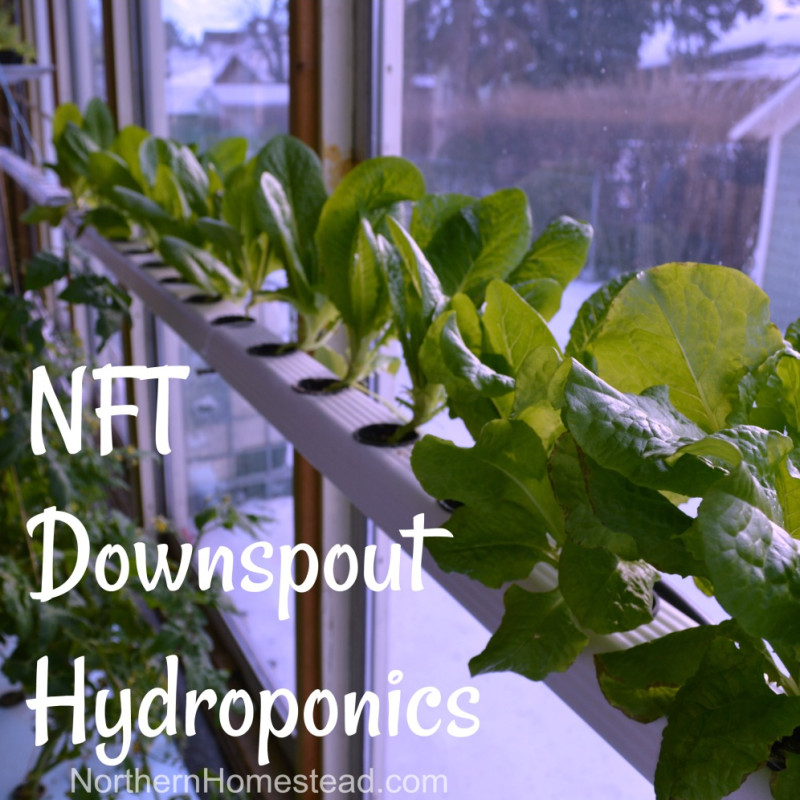
A general NFT build plan calls for a location getting roughly 6-8 hours of sunlight daily or a mix of sunlight and supplemental lighting. Temperature stability matters. The location should accommodate mature plant height and allow access to reservoirs, pumps, channels, and return lines. A 22-foot south-facing window area worked for one downspout system, letting leafy greens grow without added lighting. A 20-foot section was installed. Related lettuce notes recommend roughly 10-12 hours of light, and the system adapts to grow lights when a suitable window isn't available.
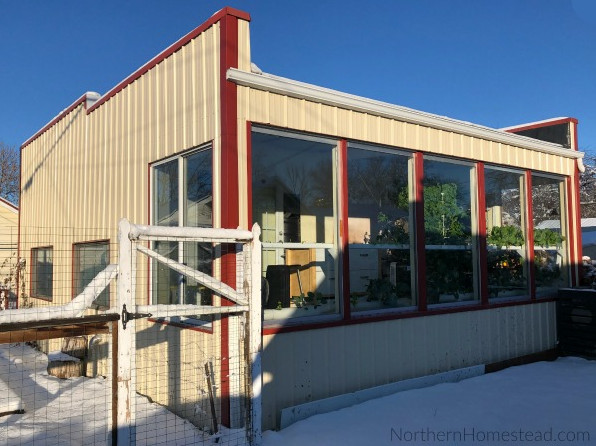
The system should be tested with water before permanent plants are added. Tests should identify leaks, verify every channel, confirm the return line, and check that the pump stays submerged. Nutrient fertilizer goes in only after the water-only test passes.
General NFT Build Process
Six-stage build overview
- Plan the layout - measure area, determine channel count and length, check light and temperature, sketch design, leave access for maintenance and harvesting, allow adequate spacing, keep reservoir below lowest point
- Build the support structure - use square metal tubing, PVC, or sturdy wooden frame; must support water-filled pipes and mature crops; reinforce joints and load points; account for future expansion; keep frame level side to side; set channels at intended slope
- Install and connect channels - cut to length, drill net-cup holes, attach with pipe clamps or fasteners, verify consistent slope, connect pump to first channel through manifold when multiple channels used
- Install reservoir and return - place reservoir below return outlets, put pump in reservoir, connect to highest channel inlet, route end of each channel back to reservoir; return should discharge below reservoir's normal water level if that prevents overflow
- Add net cups and seedlings - insert net cups into holes, fill with small amount of compatible medium, transfer seedlings when roots reach nutrient solution, confirm each root system hydrated immediately after install
- Fill, test, and start flow - fill reservoir with water, run pump, check every connection, adjust flow so film reaches lower end without flooding channel, once water-only test passes add complete nutrient solution and begin monitoring pH, EC, and temperature
Detailed DIY PVC Pipe Build
A detailed DIY account presents a core six-step sequence using PVC pipes, net cups, a wooden rack, an opaque reservoir, a submersible pump, hoses, and a timer.
Step 1: Drill and prepare the PVC pipes. Hole size should match the cup's upper rim so the cup stays supported. Net-cup spacing should account for mature crop width and space occupied by end fittings. Pipes close with fitted end caps or muffles. Cement generally needs about 24 hours to dry. Both pipe and cement should be safe for solution and plants whose harvest will be consumed. An inflow hole goes near the top of the first pipe, outflow near the bottom of the last pipe. Hose outlets should fit tubing closely and be sealed against leaks. A movable or adjustable hose position helps regulate retained water level. White PVC is preferable - less likely to heat in sunlight. If unavailable, black PVC can be painted white to reduce internal heating.
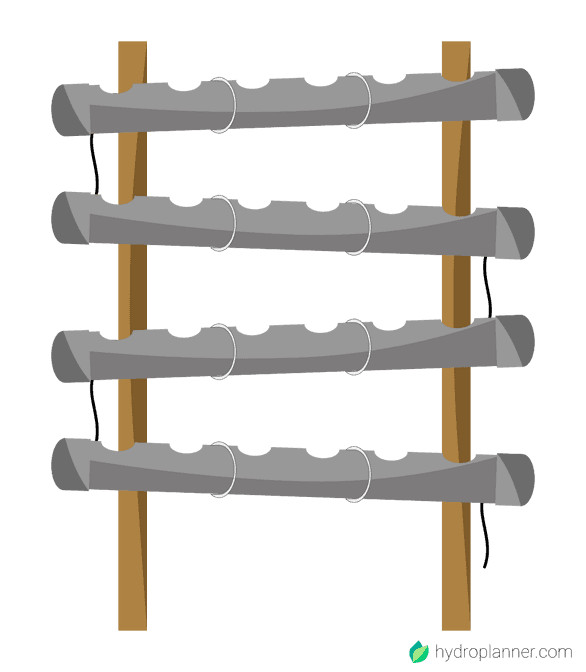
Step 2: Build a ladder or pyramid rack. A ladder-like rack leans against a wall and supports channels at multiple levels. A freestanding pyramid holds channels on both sides and increases growing capacity. A suitable rack must leave adequate horizontal and vertical room for crops, support weight of pipes, plants, roots, medium, and remaining water, allow future expansion, keep reservoir below every channel, and maintain consistent channel incline. Attach pipe clamps to the rack, then secure pipes to clamps. A zig-zag arrangement directs water progressively toward the reservoir.

The pipe angle adjusts for two operating modes. A steeper angle supports continuous natural flow. A smaller angle with raised outlet hoses retains a shallow water level between pump cycles, creating an NFT and ebb-flow hybrid. This hybrid maintains a steady level for short intervals while allowing drainage and air exposure between them. It may reduce root-zone heating and energy use compared with uninterrupted pumping.
Step 3: Set up the reservoir and connect the zigzag flow. The reservoir should be opaque, large enough, and positioned below the pipes. A bucket serves a very small install; a covered lidded container prevents light, debris, and contamination. The pump must provide enough power to lift water to the entry point. Hoses connect reservoir to highest pipe and carry solution down the zigzag. Leaving more water level inside pipes provides a short reserve if pumping stops, though substantial nutrient solution volume would reduce NFT's water- and media-efficient character. A thinner inlet hose limits water entering the first pipe during cycling - a precaution against overflow, not a guarantee if the pump is too powerful or the system unmonitored.
Step 4: Transplant seedlings. Transfer when roots reach solution through medium and net cup. Root length must match actual nutrient level. Sponge starter cubes work because they can be cut and wrapped around a seedling's roots. Clay pebbles fill the rest of the cup and absorb nutrient solution. Other compatible media work, but plant and medium must be positioned so roots reach water without being submerged too deeply.
Step 5: Prepare nutrients and program the timer. Main solution measurements are pH and TDS or EC. Fertilizer is added until solution reaches crop-specific target. A pH meter measures the value, then pH Down or pH Up reaches target range. One timer example pumps for two minutes every 20 minutes - described as a possible starting point, not a universal setting. The correct interval depends on system size, retained water level, crop load, pipe volume, and whether roots stay hydrated between cycles. Frequent short cycles maintain a shallow nutrient level and allow air to reach roots between pump runs. Roots can enlarge and obstruct hoses as plants mature, so pump performance and every channel should still be checked.
Step 6: Run and observe the system. The completed system works for vegetables, herbs, fruit, and other compatible crops. The builder recommends testing different plants, media, pipe sizes, rack structures, and layouts while regularly checking flow, water level, pH, TDS, temperature, and plant health.
DIY Vinyl Downspout System
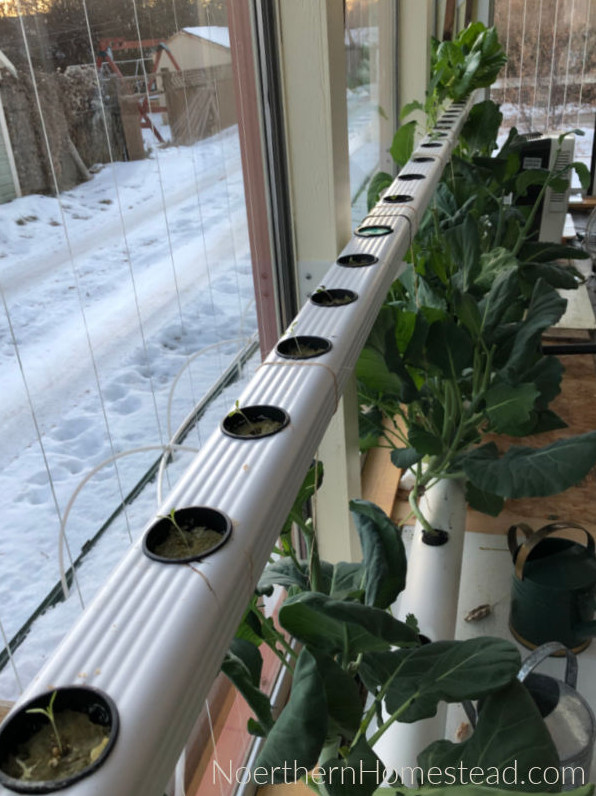
A second DIY design uses a vinyl downspout, suitable for indoor or window-side growing. The downspout is drilled for net pots, supported with U-hooks, and connected to a covered reservoir by a pump and return elbow.
The broader hydroponics approach uses nutrient-rich solution instead of soil and supports roots with inert medium like vermiculite, rockwool, peat moss, or clay pellets. A well-controlled system gives precise control over plant-growth variables, matures plants more quickly, and uses less water than soil, though the stated 25% and 30% growth and yield figures apply to hydroponics generally rather than one specific NFT design.
Downspout Materials and Assembly
Downspout system materials
- White vinyl downspout
- Amerimax white vinyl A-elbow
- Amerimax downspout flexible elbow
- Submersible fountain or pond pump rated around 200-300 gallons per hour
- One-half-inch barbed elbow fitting
- One-half-inch tubing roll
- Four U-hooks
- Electric drill with 2-inch hole saw
- 2-inch round net pots with rims slightly larger than holes
- Large clean plastic tote with lid, roughly 25-30 gallons
- Zip ties
- Air stone and air pump, or a timer
- Food-grade silicone for sealing
- Optional water heater for cold conditions
Mark and drill 2-inch holes every 6 inches along the top or wide side of the downspout. Test the first hole with a net pot before drilling all remaining holes to confirm it sits securely and won't fall through. Support the downspout with U-hooks and create a slight decline toward the outlet. The example slope is 0.5 inches over 10 feet, letting water move through without running excessively fast.
An internal green plastic barrier holds a slightly higher solution level for young seedlings - necessary when roots are too short to reach the bottom. Once roots establish, the thin nutrient film suffices for mature plants. The barrier can have bottom notches allowing water to drain between pump cycles, exposing part of the root system to air. In an alternative build, a thin HDPE cutting board served as the barrier. The downspout can be as long or short as needed, but must be long enough for the growing area and short enough for reliable flow. A 20-foot install is shown; window width determines final length.
Fasten the downspout to U-hooks with zip ties. Drill a small hole near the top of the high end and install a half-inch barbed elbow. Connect the elbow to tubing running to the submersible pump in the reservoir. The high end can close with an Amerimax A-elbow pointing upward. Another method uses heat to reshape roughly 2 inches of the downspout's underside upward to close the opening. Install an A-elbow and flexible elbow at the lower end and route the drain back to the reservoir. All pipe connections should be sealed with food-grade silicone to prevent leakage. A black tote serves as reservoir. A foam lid fits around pump and return lines. Keeping the reservoir dark limits algae, and water level must stay above the submersible pump. A bucket works for smaller installs.
Continuous and Interval Downspout Operation
A standard NFT system usually runs continuously. One downspout builder also tested interval operation: 15-minute cycles during the day, 30-minute cycles at night. The builder reports the interval schedule worked well and may increase root exposure to oxygen between cycles. If the pump runs continuously, the same system relies on an air pump and air stone to add oxygen to the solution. The reported install didn't use an air pump because the large system circulated adequately without one. A smaller or poorly circulated system may benefit from one. The grower reported using General Hydroponics MaxiGro fertilizer, while other NFT guidance recommends a complete two-part or crop-specific hydroponic fertilizer instead of a single product for every crop.
The materials used in that particular install weren't reported as independently certified food grade. Other DIY guidance explicitly calls for food-grade PVC, safe cement, and food-grade silicone. A later build can use certified components rather than relying on the earlier install's unverified status.
Continuous, Intermittent, and Hybrid Operating Modes
Although traditional NFT descriptions emphasize continuous flow, DIY builders use several related operating modes.
Continuous NFT: The pump runs continuously, solution forms a moving film, and the return line carries unused solution to the reservoir. This is the standard config in most technical descriptions. It requires continuous power and close attention to flow. Continuous NFT can have little stored water inside channels, so roots may begin wilting quickly after a pump failure. Ebb and Flow systems are more buffered because some solution remains in the growing bed between flood cycles.
Intermittent NFT: Some builders pump for short intervals and allow solution to drain between cycles. A proposed starting schedule is two minutes of pumping every 20 minutes. Another builder uses roughly 15-minute daytime cycles and 30-minute night cycles. Intermittent operation can increase root exposure to air and reduce pump energy. It's not identical to uninterrupted flow, but it can function when pipes retain a small nutrient level and roots are large enough not to dry out during the off period.
NFT combined with ebb and flow: A hybrid system uses a relatively small channel angle and raises the internal hose or standpipe to retain a shallow water level between pump cycles. The nutrient solution stays available around lower roots while air reaches upper roots. This approach can prevent root-zone damage on hot days and use less pump energy than continuous operation. The system maintains a shallow retained layer rather than a film that disappears every time the pump stops. The still water and root exposure must be managed so the lower root zone doesn't become too warm, stagnant, or anaerobic.
Plant Choices for NFT
NFT works best with rapidly maturing crops that have compact, shallow root systems. The crop must fit within channel dimensions without creating excessive root mass that blocks the water path.
Lettuce and Leafy Greens
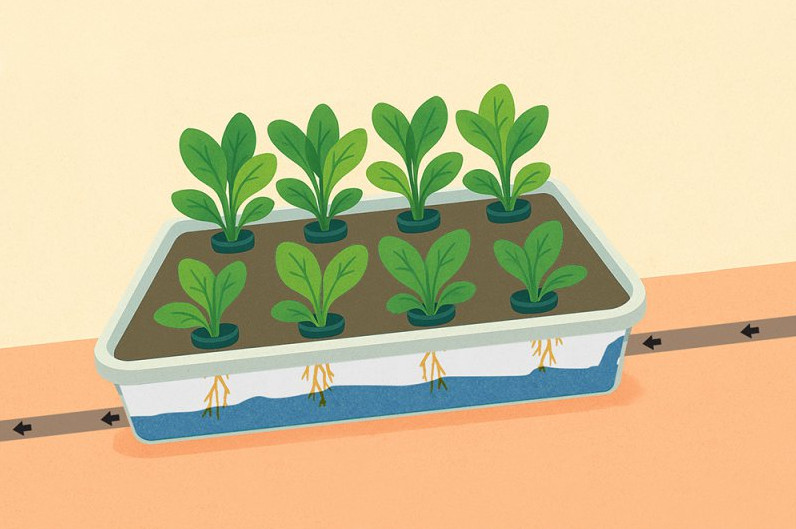
Lettuce is repeatedly identified as one of the best NFT crops. Named varieties include Butterhead, Romaine, Oakleaf, and Multi-leaf lettuce. Lettuce produces quick harvests and stays shallow enough for a nutrient film. Spacing commonly falls around 6-8 inches depending on mature variety size.
Other suitable crops include spinach, kale, mustard greens, arugula, sorrel, tatsoi, mache, frisee, bok choy, and Asian greens. These crops can be mixed to create systems with different colors, textures, and harvest times.
Herbs, Microgreens, and Larger Crops
Herbs suited to NFT include basil, mint, cilantro, chives, and parsley. Continuous nutrients and oxygen are associated with lush growth and strong aromatic oils. The comparison between NFT and soil-grown herbs isn't universal, but the described advantage is consistent access to a balanced nutrient solution.
Wheatgrass and microgreens thrive in shallow NFT channels, though specialized compact systems are often used rather than full-size commercial troughs. Their small root systems and rapid growth suit limited channel space.
Strawberries are a boundary crop. They can grow when additional plant support is provided, but their larger root and plant mass create greater demands on the channel. One overview calls kale and lettuce perennial examples, while another limits strawberries to systems with structural modification.
Crops Generally Unsuitable for Unmodified NFT
Avoid or carefully modify NFT for these crops
- Tomatoes
- Peppers
- Other large fruiting plants
- Root vegetables such as carrots and turnips
- Plants with extensive root systems
- Crops needing substantial media depth or heavy root anchoring
Large fruit crops can clog channels, shade lower leaves, add weight, and require support. Strong structural support, larger media containers, or hybrid systems combining NFT flow with deeper root media may make them possible. Those modifications can reduce or eliminate NFT's water, nutrient, space, and cost advantages, so other hydroponic systems are often more appropriate for them.
Commercial operations, however, grow cucumbers, tomatoes, peppers, strawberries, and leafy greens in managed NFT installs. The difference is that commercial facilities use larger channels, engineered support, redundancy, and dedicated crop-management procedures. The view that tomatoes and peppers are unsuitable applies mainly to small or unmodified channels.
Spacing, Crop Density, and Direct Seeding
Plant spacing should be based on mature size. Lettuce may space roughly 6-8 inches apart. A downspout example uses holes every 6 inches. A PVC example placed seven cups per meter but noted fewer holes may have been preferable for the intended plants. Overcrowding creates large root masses, blocks the channel, reduces airflow around leaves, and increases the risk that only part of the root system receives nutrient solution. Wide or spreading crops need more room than upright crops.
Most NFT systems aren't designed for direct seeding. The solution is too shallow to keep a seed bed consistently wet, and the seed may not have enough moisture to germinate. Seedlings should start in a separate propagation medium and transplant after roots are long enough to reach the solution.
Cleaning and Maintenance
Regular maintenance keeps the film flowing and roots healthy. NFT has few moving parts, but those parts are critical.
Preventing Root Clogs
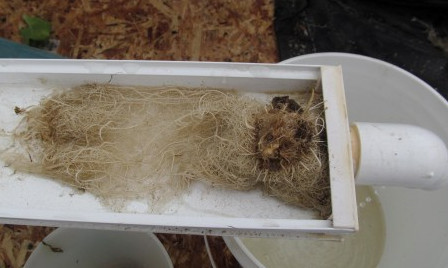
Roots can grow together and form a dam that blocks the channel. Prevention includes matching crops to channel width and length, maintaining appropriate flow, inspecting the channel throughout the crop cycle, removing plant debris, cleaning channels during crop changes, trimming or removing roots when they obstruct drains, and avoiding oversized or deep-rooted crops in small channels.
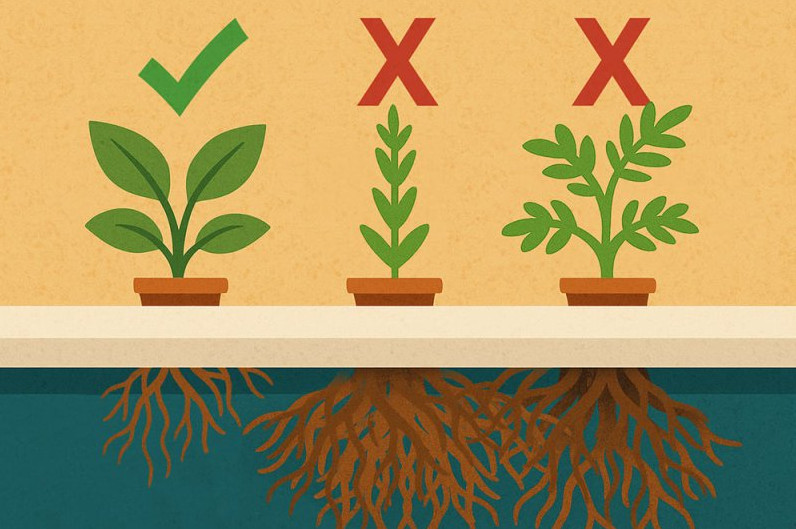
A root mass can reduce flow before it becomes obvious at the reservoir. Plants near the beginning of a blocked channel may stay healthy while downstream plants show reduced growth. Large roots can block a drain or prevent the film from moving across the full channel. Trimming roots in these cases is a fundamental maintenance task.
Preventing Algae and Cleaning Schedules
Algae grow when light reaches nutrient-rich water. Prevention includes using black or opaque reservoirs, keeping the reservoir covered, using opaque tubing where practical, preventing light from entering channel joints, removing debris that blocks or shades water surfaces, and emptying and cleaning the reservoir when buildup appears. One maintenance passage gives hydrogen peroxide as an algae-control treatment: 3 ml of a 3% solution per gallon. It should be used only as specified because concentrated peroxide can affect plants and system components.

Basic cleaning tasks include removing plant debris, scrubbing channels during crop rotation, checking channel walls for mineral deposits, cleaning or replacing the reservoir filter, cleaning the pump and its intake, inspecting or replacing tubing, sanitizing the entire system between major crops, and keeping sensors and optical surfaces clean. A basic NFT maintenance plan calls for complete system sanitization twice a year, while a more formal commercial schedule calls for thorough annual sanitation. Cleaning frequency can increase between crops, after root clogging, during persistent algae problems, or when mineral deposits restrict flow.
Downspout System Cleaning
In the downspout example, the reservoir is emptied and the pump cleaned about twice a year or as needed. The complete pipe system gets a deep cleaning once a year. During that cleaning, pipes are disassembled, scrubbed inside and outside, rinsed, and reinstalled. Replanting is done by removing the old plant and roots, cleaning the reusable net cup, and inserting a new clean seedling and medium. Because all nutrient solution is held in one accessible container, reservoir cleaning and refilling are comparatively direct.
Pump Failure, Power Loss, and Leaks
A stopped pump is the primary failure point in NFT. Plants can begin to wilt within hours, and a short interruption can be more damaging than in a buffered system. Possible causes include pump failure, power outage, blocked inlet, clogged channel or return, empty reservoir, pump pulled above water level, failed timer, overheated water or inadequate aeration, excessive root growth, and sediment or biofilm restriction.
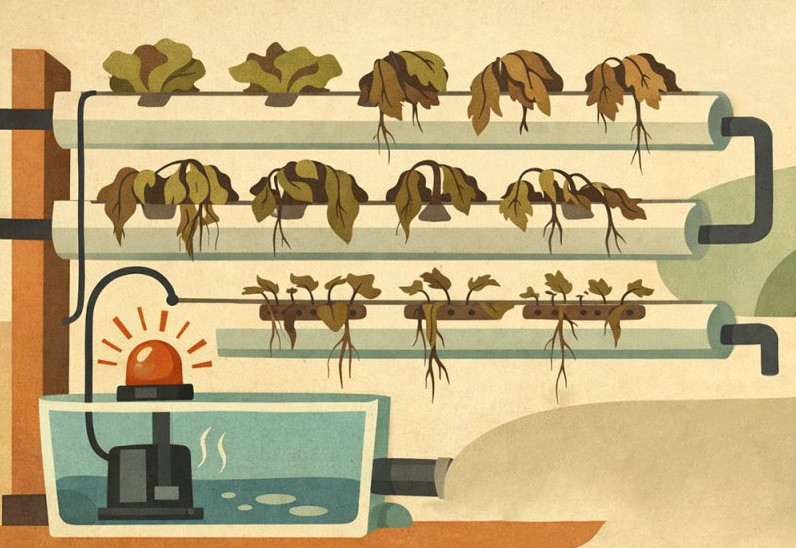
Commercial systems may lose an entire crop in hours. Small systems may fail more quickly because they contain less stored solution. A pump can also fail if debris accumulates in the impeller or if the reservoir level drops too low.
Backup measures include a second pump, battery-backed or generator power, high/low water or flow alarms, a manually checkable reservoir level, frequent physical inspection, a design that includes some retained solution or hybrid operation, and backup pumps and power at commercial scale. A pump and power backup should match the installation size. A backup device that can't lift solution to the system's high point isn't sufficient.
Leak Sources and Repairs
Leaks can occur at pipe junctions, unsealed end caps, the reservoir edge, pump-to-channel connection, channel-to-return connection, damaged tubing, reservoir lids, and around net cups or improperly drilled holes. A small leak can be addressed by locating the source, using a sealant safe for the solution and pipe material, allowing the sealant to cure for the stated period - commonly about 24 hours - and then slowly refilling the system. Leaks can also result from root blockage forcing solution out of the channel. A weekly inspection during growing season identifies loose joints and developing overflow points before nutrient solution is lost.
Why NFT Is Considered Beginner-Friendly
Characteristics making NFT accessible for beginners
- The operating principle is simple
- The system uses relatively few essential parts
- Roots remain visible and can be inspected
- Channels can be arranged vertically to increase growing area
- The pump can run without a complex timer in continuous designs
- The reservoir concentrates the nutrient solution
- The system can be built with inexpensive PVC, a tank, a pump, and net cups
- Small versions fit indoors near a window
- Shallow crops have relatively modest support and root-space requirements
Vertical arrangements increase growing area above the footprint of a single horizontal row. NFT expands by adding more channels to a manifold, provided the pump, reservoir, and maintenance routine are sized for the additional load. The closed loop protects groundwater from nutrient contamination by preventing nutrient-rich discharge from entering the ground. It also reduces the water and fertilizer volume needed for compatible crops.
Why NFT Can Be Too Demanding for Beginners
Another perspective argues that NFT should be avoided by small growers and first-time hydroponic operators, despite its favorable nutrient and oxygen pattern. The central issue isn't whether NFT can produce strong results - it's whether one person can detect and correct every failure quickly enough.
NFT requires control over nutrient-solution flow, channel slope and alignment, reservoir level, nutrient chemistry, pH, EC or TDS, solution temperature, dissolved oxygen, root size, channel and return cleanliness, sanitation, pump operation, and electrical power. Each variable is also a possible failure point. Power failure, root blockage, warm solution, cold solution, poor distribution, or disease can all become serious quickly.
Commercial operations dedicate staff to monitoring crops, establish standard procedures, use turnkey systems, and maintain redundant pumps and power. Small growers divide attention among crop work, finances, distribution, family responsibilities, or other employment. A problem caught in minutes during a commercial inspection can remain unnoticed for a day.
The Speed of Consequences
The time between a mistake and a visible result is short in NFT. A partially blocked channel can lower nutrient supply for downstream plants before roots show obvious damage. A pump failure can wilt plants within hours. A diseased root can spread through the recirculating solution. In one reported case, a grower didn't notice the start of a fungal disease for 24 hours. Inadequate sterilization of the recirculating solution contributed to a major loss of lettuce plants. Lettuce may recover more readily because its crop cycle is short, while a delayed disease problem in a flowering crop with a long production cycle can be much more damaging. NFT can spread disease rapidly when plants share the same recirculating solution.
Problems That Reduce Yield Without Obvious Failure
Not every NFT problem causes sudden wilt. A long channel can let plants at the inlet remove too much of a nutrient before solution reaches the far end. The result may be lower yield or uneven maturity even though the pump and pipes operate normally. Other gradual problems include nutrient depletion at the end of a channel, uneven flow from an unbalanced manifold, mild oxygen deficiency, excess solution temperature, slow mineral deposits, gradual root obstruction, pH or EC drift, and sensors no longer accurate.
Small growers may interpret these implementation problems as evidence that NFT inherently has low yield. At commercial scale, the same problems get addressed through consultants, standardized operating procedures, engineered system layouts, and dedicated monitoring.
Advantages of NFT
Key advantages of nutrient film technique
- Water efficiency - up to 90% reduction compared with traditional soil agriculture
- Continuous nutrient availability - unused solution stays in circulation for later use
- Root oxygen exposure - upper roots access atmospheric oxygen while lower roots get nutrient film
- Space efficiency - shallow channels install in vertical or horizontal configurations
- Scalability - start with a few channels, add more as pump, reservoir, and monitoring capacity allow
- Reduced media use - less purchase, handling, disposal, and labor for growing media
- Direct root inspection - exposed roots make it easy to spot disease or clogging early
- Closed-loop nutrient reuse - recycles solution rather than sending it to drainage
Limitations and Failure Risks
Main limitations of NFT systems
- Pump and power dependence - very little buffering compared with systems retaining larger nutrient solution bodies
- Initial technical setup - requires accurate slope, flow, return alignment, reservoir sizing, and channel placement
- Channel length limits - long channels create nutrient gradients reducing far-end performance
- Root clogs - large roots and dense plantings block flow or drains, requiring trimming and cleaning during crop
- Temperature sensitivity - warm solution loses oxygen and increases disease risk; cool solution slows uptake
- Crop limitations - large fruiting plants and root vegetables need more root depth, support, and media
- Dependence on sanitation and monitoring - closed loop recirculates pathogens; small infections affect many plants
- Commercial controls - redundant pumps, backup power, continuous sensors, standardized maintenance, environmental controls, and dedicated operators add cost and complexity
Commercial Versus Small-Scale Use
NFT can be highly productive at medium and large commercial scales. A commercial system justifies added engineering when it eliminates much of the media cost and labor, uses water and fertilizer efficiently, and produces the same or higher yield as a media-based system.
Large growers use NFT for leafy greens, lettuce, cucumbers, tomatoes, peppers, and strawberries. Commercial systems may have decades of collective experience behind their procedures. Turnkey suppliers define expected crop performance and provide established responses to issues like nutrient imbalance, root disease, channel distribution, and pump failure.
Small growers may have less labor, fewer monitoring hours, and fewer backup resources. For reliable first-time production, small-grower guidance recommends considering a more forgiving system even if it uses more water or medium. DWC is an easier alternative for growers who want to avoid media. Open media-based systems have high success rates and lower starting costs, though they're less efficient in water, fertilizer, and space use. NFT can be introduced after the grower has experience managing a more forgiving system and is prepared to monitor the additional failure points.
NFT Compared with Other Hydroponic Systems
NFT, Flood and Drain, Deep Water Culture, and the Kratky Method all use nutrient solution without soil, but they expose roots to water and oxygen differently.
Flood and Drain (Ebb and Flow)
A flood and drain system periodically fills a grow bed with nutrient solution and then drains it back to a reservoir. A timer and pump control the cycle, and an overflow or drain fitting removes excess solution. The pump fills the bed to a set level, roots soak in the nutrient solution, the timer stops the pump, excess solution drains, and roots receive oxygen while the bed is empty. Benefits include oxygen exposure during drain cycles and suitability for a wider range of plants. Main challenges are dependence on a timer and pump and the need for regular cleaning to prevent clogs, mineral deposits, and algae. Flood and drain supports tomatoes, peppers, cucumbers, herbs, and other plants less suitable for shallow NFT channels. It also has more stored solution and more buffered root conditions during a short pump interruption.
Deep Water Culture
Deep Water Culture suspends plant roots in an aerated nutrient reservoir. An air pump and air stone commonly oxygenate the solution. Roots submerge in nutrient solution, net pots support plants above the reservoir, air stones or another aeration method add oxygen, and pumps or air systems circulate and aerate the solution. Benefits include rapid growth, relatively simple construction, and constant access to dissolved nutrients and oxygen. Main challenges are sensitivity to pump or aeration failure and the need to control solution temperature. DWC suits lettuce, herbs, and some small fruiting plants. Compared with NFT, DWC uses a much larger nutrient volume and more of the root system stays submerged, so temperature and dissolved oxygen require close attention.
Kratky Method
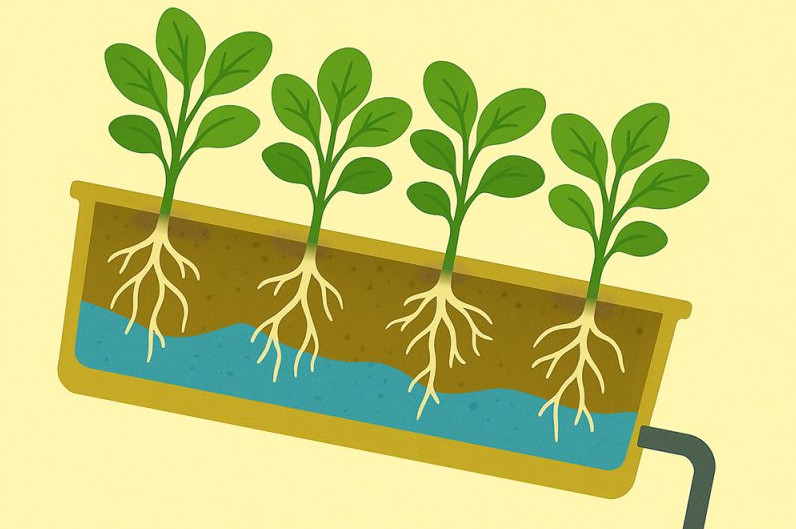
The Kratky Method is a passive system where plants grow in a sealed container with nutrient solution below the roots and an air gap above it. A container holds nutrient solution and plants, lower roots remain in or near the solution, an air gap gives upper roots access to oxygen, and the system isn't continually circulated by a pump. Benefits include low maintenance, few moving parts, and low equipment cost. Main challenges include limited suitability for large plants and the need to monitor solution level. Kratky suits small, fast-growing plants like lettuce and herbs.
Aeroponic and Drip Systems
NFT is one of several hydroponic categories alongside water culture, flood and drain, drip irrigation, and aeroponics. Drip systems can be recovery or non-recovery systems. Aeroponic systems expose roots to a mist or spray rather than a nutrient film. The supplied material doesn't compare their detailed operation or performance with NFT.
Oxygen Requirements Across Systems
Oxygen is required for root respiration, nutrient uptake, and plant growth. Low oxygen causes root rot, reduced nutrient absorption, and stunted growth. NFT provides oxygen by leaving upper roots exposed to air and moving nutrient solution through the channel. Some descriptions call this superior oxygenation, while another comparison notes flow-related oxygenation can be limited and the exposed root zone must be preserved. Flood and drain provides oxygen during drain periods. DWC uses an air pump or air stones to add oxygen continuously. Kratky provides oxygen through the air gap between solution level and upper roots. Oxygen availability changes with temperature - warmer solution holds less oxygen, so a system adequately aerated in cool conditions may become oxygen-limited during high temperatures.
Factors for Choosing a Hydroponic System
The method should match the crop, growing space, power reliability, budget, and level of monitoring available. NFT fits shallow, fast-growing crops when continuous or carefully timed flow can be maintained. Flood and drain or deeper media systems accommodate crops with more extensive roots or heavier plant support. DWC offers simple nutrient and oxygen delivery for crops tolerating submerged roots, while Kratky suits small plants and low-maintenance passive setups.
Small-grower guidance gives particular attention to reliability. A more forgiving system may use additional water or medium, but it reduces the number of rapidly developing failure points. Once pump operation, nutrient monitoring, sanitation, and root maintenance are understood, NFT provides high water efficiency, low media use, rapid nutrient delivery, and high space utilization.
The method used should correspond to the crop, growing space, power reliability, budget, and level of monitoring available.
I've found that understanding these trade-offs matters more than chasing the "perfect" system. Just like how some people chase quick returns without understanding the mechanics , jumping into NFT without grasping the monitoring demands leads to frustration. The system rewards attention to detail - not unlike any setup where small parameters compound over time .
If you're just starting, don't feel pressured to build the most efficient system first. A simpler approach lets you learn the rhythms of plant growth, nutrient management, and failure detection. You can always add complexity later when the basics feel boring . The plants don't care about your ego - they care about consistent conditions.
One thing I appreciate about NFT is how it forces you to think in systems: flow rates, channel geometry, reservoir sizing, pump curves. It's the kind of problem that appeals if you enjoy tuning parameters and watching feedback loops . But it punishes neglect faster than most other methods.
For anyone curious about the broader landscape, there are parallels in any field where efficiency meets fragility . The principles transfer - monitoring, redundancy, graceful degradation. Whether it's roots or routers, the engineering mindset stays the same.
Comments on “Nutrient Film Technique: How to Build an NFT Hydroponic System”
No comments yet. Be the first to share your thoughts.