Making Money in Crypto: A Plain-English Look at Methods and Risks
How to Make Money in Crypto: Methods and Risks Compared
I keep coming back to the same question from people: how to make money from crypto . The answer isn't one-size-fits-all. There are a few real paths, and each comes with its own risks and trade-offs. I'll walk through what the source material covers, plain and simple, so you can decide what fits your situation.

Two Primary Routes to Cash
The Milo article lays out the main cash outcomes in two paths. You either keep the holdings and borrow against part of the position, or you hold until the position appreciates and sell a slice for cash. Other crypto income methods can supplement these paths, not replace them.
Most people searching for how to make money from crypto or Bitcoin are seeking fiat outcomes. Earning extra coins is different from having spendable currency, realized gains, or cash flow. That distinction matters more than most newcomers realize, and mixing up coins with cash can lead to bad decisions.
The article divides the main cash outcomes into two paths: keep the holdings and borrow against part of the position, or hold until the position appreciates and sell a slice for cash.
Borrowing Against Part of a Crypto Holding
Bitcoin's long-run growth story is compelling, but Bitcoin is also volatile and non-yielding on its own. Borrowing against part of a holding can give you cash without selling the entire core position. The borrowed funds can go into productive or cash-generating assets, adding income streams that don't move perfectly with crypto.
This approach combines price appreciation with income. The holder keeps the asset they believe in while adding cash flow that could fund life expenses, build credit history, or smooth market cycles. Depending on the jurisdiction and structure, it may also let unrealized gains support liquidity while deferring a taxable sale.
The source also notes that cryptocurrency loans without collateral are not what this path is about - this is about using crypto as collateral, not getting a loan with no backing. Understanding how do crypto loans work starts with knowing that the loan is secured by the asset you hold.
Reasons for borrowing against crypto
- Adding independent return drivers such as rent or dividends
- Turning unrealized gains into usable cash flow
- Preserving participation in future price appreciation because the core stack stays intact
- Creating optionality - cash flow can service debt, buy market dips, or fund other opportunities
- Keeping exposure to a long-term crypto position rather than liquidating it
A Crypto-Backed Mortgage
A crypto-backed mortgage can be used to acquire investment property. The property's rent may create an income stream described as "bitcoin-yield" while the BTC underpins the financing. BTC can serve as pledged collateral or as holdings recognized as reserves.
Borrowed proceeds can also go into assets the borrower understands: a cash-generating business, selected equities that pay dividends, income funds with clear risk controls, or other productive assets that can cover the loan's interest expense.
Loan sizing should be conservative. Cash flow from the acquired asset should cover the interest with room to spare, and the borrower should keep a liquidity buffer for unexpected expenses.
Centralized and Decentralized Lending
Centralized lenders may provide custody, disclosures, service, and cure windows. The borrower gives up unilateral control of pledged assets in exchange for institutional safeguards and more clearly defined operations.
Decentralized protocols enforce rules through smart contracts with public parameters and on-chain execution. This model can offer transparency and 24/7 access, but borrowers take on monitoring duties, smart-contract risk, and code governance risk.
The choice depends on custody preferences, operating style, and how actively the borrower wants to manage the position.
Risk Controls for Crypto-Backed Borrowing
The source lists a solid set of risk controls. Matching durations is key - long-term assets should not be financed with short-fuse liabilities. Keeping loan-to-value conservative matters too. Pre-funding liquidity for collateral top-ups helps when markets move fast.
Model a worst reasonable drawdown. Test the plan against an interest-rate increase. Confirm that cash flow still covers payments under stressed conditions. Keep a reserve for repairs, vacancies, or collateral calls.
Document the arrangement. Expect wallet proofs and ownership links if BTC is counted as reserves. Track the tax treatment of interest expense based on the use of proceeds and the applicable jurisdiction.
Price interest, closing costs, custody or servicing fees, taxes, and time. Avoid a structure that depends on maximum leverage to appear workable. This path is less suitable if the borrower can't monitor the position, has unstable income, or needs maximum leverage to make the cash flow work.
Selling Part of a Crypto Holding After Appreciation
Selling a fraction after gains is the simplest way to turn Bitcoin into cash without adding leverage. The holder lets the position appreciate, establishes rules in advance, and converts a slice into fiat when specified targets are reached. The proceeds can fund investments, rebalance a concentrated position, diversify a balance sheet, or meet personal goals.
There are no margin calls, collateral top-ups, cure windows, or custody transfers tied to the sale itself. The trade-off is a tax event and reduced exposure to future gains if the rally continues.
Locking in part of the advance while retaining exposure to further upside - that's the core idea behind partial sales.
Rules and Tranching
Rules should be written before execution. Sell bands can specify when to act, either at set price levels or on a fixed schedule. Many investors use tranching, which breaks one sale into several smaller sales over time.
For example, after a 50% gain, an investor might sell 10% of the position, another 5% if the price rises another 10%, and a final 5% if it rises further. Tranching can reduce the chance of selling too early, limit regret if the rally continues, and still produce cash along the way.
Limit orders can control slippage and avoid illiquid trading hours. Accurate cost-basis records are important so tax reporting reflects the specific lots sold.
Simple Appreciation and Partial-Sale Example
Starting position: $300,000. Appreciation of 50% brings it to $450,000. Selling 20% of the position yields $90,000 gross. Capital gains and fees come off the top for the net deployable amount. Remaining exposure is 80% of the original position.
Selling part of a position creates a tax event and reduces the amount participating in future gains if the rally continues. Price appreciation after the sale can also cause psychological regret. Written tranching rules can reduce that uncertainty. The benefit is that the remaining process is straightforward and doesn't introduce collateral mechanics.
This path fits an investor who wants liquidity without leverage, prefers simplicity, is willing to realize gains, can follow written sell rules, is rebalancing concentrated holdings, or wants to manage tax timing.
Criteria for Choosing Between Borrowing and Selling
Borrowing against crypto is more applicable when there's a specific project with measurable yield, such as an investment property financed with a crypto-backed mortgage. It also fits when the new asset's cash flow can cover interest with room to spare, the borrower wants to retain long-term crypto exposure, and the borrower is comfortable with collateral rules and routine monitoring.
Selling part of the position is more applicable when clean liquidity is needed without collateral mechanics or top-ups, simplicity is more important than retaining every unit, and accepting a current tax event is preferable.
Psychology is part of the decision. Some holders are more comfortable monitoring property and a loan than parting with a core crypto position. Others prefer the simplicity of a realized gain and a funded goal.
Factors to weigh
- The amount of cash actually needed
- The desired amount of continued crypto exposure
- The ability to monitor positions
- Time horizon
- Comfort with leverage and collateral rules
- Preference for institutional service versus self-management
- Willingness to realize gains now
- Need to rebalance concentrated holdings
- Stability of income used to make payments
- Capacity to manage taxes, fees, and reporting
Neither path is universally superior. The appropriate structure depends on time horizon, operational capacity, and appetite for complexity. Run the numbers for the specific situation, with both a base case and a stress case. Each plan should remain workable after a reasonable drawdown and a reasonable rate shock.
Crypto Basics and the Three-Step Investing Framework
A Trader article outlined a three-step strategy: understanding cryptocurrency, selecting investments, and creating a diversified portfolio. The subheading was "Crypto Invests for the Future."
Cryptocurrencies are digital assets that use encryption techniques to secure transactions and help control the creation of new units. Popular examples named in the source include Bitcoin, Ethereum, and Litecoin.
The term breaks into "crypto" and "currency." The prefix "crypto" comes from the Greek word "kryptos," meaning hidden or secret. Cryptography is the science of writing and solving codes and the basis for cryptocurrency transactions. It uses mathematical algorithms and protocols to protect transactions and create a secure online network.
Currency is a medium of exchange, including physical coins and bills as well as electronic forms such as PayPal and credit cards. Crypto uses digital tokens and assets recorded on a blockchain ledger. Each transaction is recorded on the blockchain.
The article describes cryptocurrency as decentralized, not backed by a government or central bank, and usable around the world. It presents crypto as capable of being used for payments, storing value, trading, and making money online.
One article states that crypto payments can be sent anywhere in the world within minutes, with no fees or restrictions. This broad claim differs from the Stripe payment-infrastructure material, which notes low fees and geographic complexity. The claims differ in scope, and the general article overstates what's realistically available today.
Basic Research Steps
Basic research steps include learning how the cryptocurrency market works, understanding how individual cryptocurrencies function, following market trends, researching projects before investing, investing only what can be affordably lost, recognizing that cryptocurrency markets are volatile and can be unpredictable, selecting a secure digital wallet, and choosing between hardware and software wallets according to security needs.
One thing I'd flag: the source says to learn how do crypto markets work before putting real money in. That's not sexy advice, but it's the kind of thing that saves people from expensive mistakes.
Selecting Crypto Investments
The article identifies Bitcoin and Ethereum as well-established cryptocurrencies with longer track records than newer options and describes them as more stable than some newer coins. It also suggests researching smaller or newer projects that have a strong team, a clear development roadmap, potential for growth, and a defined purpose or use case.
Diversification is recommended across multiple coins and tokens so that one asset does not determine the entire portfolio's performance. A reputable exchange or investment platform may also be used. Security features to compare include two-factor authentication and insurance coverage.
Building a Diversified Crypto Portfolio
At the time of the three-step article, more than 8,000 cryptocurrencies were said to exist. Different assets serve different purposes, including mediums of exchange, stores of value, investment assets, and other use cases.
Portfolio diversification approaches
- Asset purpose - hold assets designed for different purposes rather than relying on one category
- Market capitalization - large-cap assets such as Bitcoin and Ethereum are described as less volatile than small-cap assets, but they may also offer lower returns. A mix of large-cap, mid-cap, and small-cap can balance risk and reward
- Risk profile - some cryptocurrencies are more stable, while others are more volatile. Combining assets with different risk profiles can balance potential returns against volatility
- Asset count - investing in a range of coins and tokens can reduce concentration risk and prevent all funds from being exposed to the same project or market condition
Trading and Investing in Crypto Projects
A Motivation article by Maryam Moulana described a process for getting started: learn how cryptocurrency markets work, understand different types of cryptocurrencies and how they function, learn how to buy and sell crypto, learn how to store crypto securely, set up a cryptocurrency wallet, buy coins through an exchange or transfer them from another wallet, buy and sell crypto on an exchange, use crypto to purchase goods or services where accepted, use crypto to trade in financial markets, invest in crypto projects or initial coin offerings, borrow coins through a lending service by providing collateral, and mine cryptocurrency using computing power.
A cryptocurrency wallet is compared to an online bank account that stores digital currency. Hardware and software wallets are both mentioned as storage options.
Day Trading
Day trading involves buying and selling crypto assets within a single day to capture price movements. It can produce gains when timing and market analysis are correct, but the source also identifies it as risky. Research and an understanding of market risk are required before trading.
General crypto trading can involve buying and selling different cryptocurrencies to generate profits. The broader summary of crypto earning methods lists buying low and selling high, trading, mining, staking, lending, and holding.
Longer-term participation is also discussed through holding and dollar-cost averaging. A Lark Davis podcast outline presents dollar-cost averaging as an easy way to invest and includes a separate segment about a long-term strategy for moving money and earning more over the years. The available episode outline does not provide detailed mechanics or a comparative return figure for that strategy.
Initial Coin Offerings and New Projects
ICOs are described as crowdfunding campaigns for cryptocurrencies. Developers issue tokens that investors can buy in hopes of future profits.
The source characterizes ICO investing as a high-risk approach because there is no guarantee that an ICO will succeed, the project may not achieve the expected results, token prices and project outcomes are uncertain, research is required before participation, and the potential advantages and disadvantages should be weighed before investing.
A separate project-selection framework suggests examining whether an emerging project has a strong team and a clear development roadmap. Investing in a project should be based on research rather than the number of coins available or the assumption that a newer token will outperform established assets.

Mining and Methods That Can Reward More Coins
Cryptocurrency mining uses computing power to solve complex mathematical problems. In return, the miner can receive newly created coins.
The source describes mining as a possible way to earn a steady income, but also notes that it is not available to everyone without preparation. It can require specialized mining hardware, specialized mining software, a mining rig, upfront money, time to install and operate the system, and ongoing operation and maintenance.
The Lark Davis podcast outline raises environmental questions about Bitcoin mining. One segment is titled "Is Bitcoin bad for the planet?" and examines Bitcoin mining and the e-waste controversy. The outline does not state a final conclusion to that discussion.
Staking and Other Crypto Reward Methods
In addition to mining, the sources list staking, liquid staking tokens, yield farming, lending that produces rewards, liquidity provision, and options income. These approaches are described as ways to earn more coins or add income. Providing liquidity and using options are also identified as possible income methods.
The reward may be additional crypto rather than immediate fiat currency. The source specifically warns that these methods do not reliably put cash directly into a bank account without extra steps. A holder may first need to convert the rewards, sell a portion, use a payment service, or otherwise arrange a fiat outcome.
For best crypto apy staking and what is staking crypto , the key point is that staking crypto currency can grow a crypto stack, but it does not automatically place cash in a bank account. Additional steps are needed to turn rewards into spendable currency, realized gains, or cash flow.
Borrowing and Lending
The term lending is used in more than one way across the source material.
Collateral borrowing: some exchanges offer lending services in which a person borrows coins and provides crypto as collateral. The borrower must manage the loan and collateral position. Borrowing against a long-term crypto holding can also fund a property, business, equities, or income funds.
Crypto-backed borrowing: a crypto mortgage can use BTC as collateral or as holdings recognized as reserves. The borrower retains exposure to BTC while using the property or another productive asset to create cash flow. Interest, loan-to-value limits, collateral top-ups, duration, taxes, and rate changes must be accounted for.
Reward lending: lending crypto out is also listed as a method that can reward the lender with more coins. The source materials do not provide a specific lending rate, term, minimum balance, or reward schedule.
Receiving Payments in Crypto
Crypto can also be used to receive earnings rather than only as an investment asset. A Stripe Crypto article by Karan Sharma describes crypto payouts for creators, freelancers, sellers, and solopreneurs.
Stripe Connect was built to help businesses send payouts programmatically. The article states that businesses around the world use Connect to send payouts to more than 70 countries in local currencies. Some countries remain outside Stripe's coverage because local payment systems are heterogeneous and complex.
The article contrasts crypto's "store of value" role with its potential to function as open-access global financial rails. It introduces crypto payouts for Connect as a way to extend money movement beyond traditional payment rails.
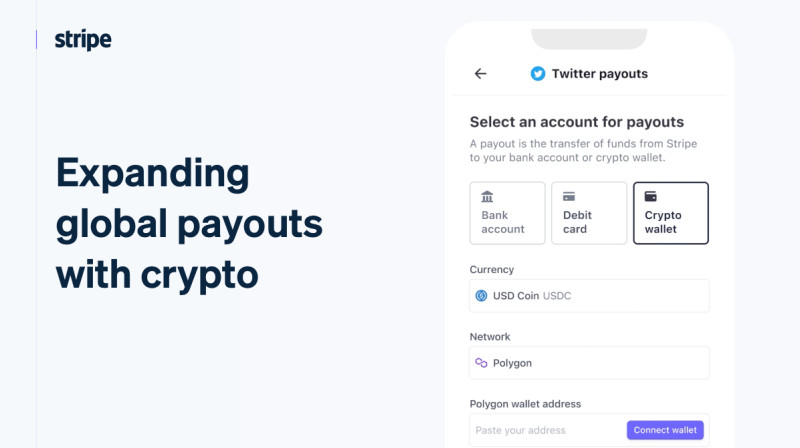
Twitter was the first partner for the crypto-payout pilot. A select group of Twitter creators could opt to have earnings from Twitter's monetization products paid to a cryptocurrency wallet. Twitter already used Connect to pay creators for products including Ticketed Spaces and Super Follows.
Stripe said it would handle the crypto-related complexity and operations. The platform did not need to make code changes, acquire crypto, store crypto, or transfer crypto itself.
Stripe initially supported payouts in USDC, a stablecoin pegged to the U.S. dollar. The article says this could allow people who could not otherwise hold dollars to receive dollar-linked digital assets. The stablecoin apy on USDC is something to check if you're considering holding rewards in that form.
Payouts were initially sent over the Polygon network. Stripe selected Polygon because of low fees, speed, integration with Ethereum, and broad wallet compatibility. Compatible wallets named in the article include MetaMask, Coinbase Wallet, and Rainbow. After receiving USDC, a creator could hold the balance on Polygon or bridge it to Ethereum and exchange it into another currency.
Creators and freelancers who opted into crypto payouts went through Stripe's normal onboarding process. Stripe performed comprehensive KYC, and the onboarding flow was designed to adapt as cryptocurrency regulations changed. Creators could manage account details, track earnings in real time, and view upcoming payouts in the Stripe Express app.
Stripe described this capability as an extension of its Global Payments and Treasury Network, or GPTN. The GPTN is infrastructure and a service architecture for global, programmable money movement. The article said Stripe planned to support crypto payouts in more than 120 countries and invited platforms to request access to the beta.
Esther Crawford, Product Lead for Creators at Twitter, said: "Twitter is where people go to have conversations about what's happening. We're focused on helping creators who drive those conversations earn money and connect with their audiences in new ways. We're excited to begin offering crypto payouts to creators via Stripe so they have more choice in how they get paid."
Beginner, Security, and Market Topics in the Lark Davis Discussion
A Melissa Ambrosini post centers on a podcast conversation conducted by Nick Broadhurst with Lark Davis. The post describes Davis as a Bitcoin, cryptocurrency, and stock investor with years of experience making consistent profits and helping his community. His YouTube channel had more than 365,000 subscribers.
The post says that understanding and trading crypto transformed the hosts' personal finances and portfolio. The questions framed for the discussion include: what crypto is without technical jargon, how Bitcoin works, why the technology is considered disruptive, how to keep an investment safe, whether someone who has never traded can create wealth with crypto, which cryptocurrencies to choose, how to get started, and how to evaluate whether crypto is being presented accurately.
Episode outline topics and timestamps
- How Lark Davis became expert in crypto and his rise as a crypto influencer - 08:31
- Crypto 101, including what Bitcoin is, how it works, and why the technology is exciting - 12:49
- Bitcoin's environmental impact, mining, and e-waste controversy - 16:31
- Nick Broadhurst's discovery of cryptocurrency's potential and the start of his investment journey - 21:14
- Crypto's potential for women and ways to encourage more participation - 25:05
- Bitcoin, Ethereum, and Ripple, including how to choose where to invest and what may come next - 30:04
- Making money through banking platforms - 38:53
- How to get started with crypto, including apps and platforms - 45:27
- Keeping crypto investing simple through dollar-cost averaging - 49:28
- Keeping investments safe and managing personal risk - 53:13
- Having enough time to invest and using a long-term money strategy - 59:54
- Password and wallet safety, including disaster stories about lost or insecure information - 1:05:20
- Elon Musk and the Dogecoin hype - 1:12:48
The podcast post states that the episode is for information only and should not be relied on as the basis for an investment decision. It advises viewers to obtain independent legal, tax, and regulatory advice before investing. It also recommends consulting a licensed financial adviser about the suitability of an investment product, taking into account the investor's objectives, financial situation, particular needs, and ability to assume risk.
The episode resources named in the post include Lark Davis's YouTube channel, Wealth Mastery Newsletter, Catherine Wood, Laura Shin, Unchained with Laura Shin, The Cryptopians by Laura Shin, Michael J. Saylor, Coinbase, Binance, Crypto.com, and EllioTrades Crypto.
Cross-Method Risks and Controls
Crypto is repeatedly described as volatile, unpredictable, and capable of producing losses. The basic investing guidance is to invest only what can be afford to lose. Bitcoin can appreciate over a long period, but it can also drawdowns sharply. A strategy that works in a base case may fail after a large price decline.
Risk categories across all methods
- Market volatility and loss risk - crypto is volatile and unpredictable; invest only what can be afford to lose
- Concentration risk - putting all funds into one coin, token, project, or position exposes the portfolio to a single failure; diversification across assets, purposes, market caps, and risk profiles spreads risk
- Leverage and collateral risk - crypto-backed loans add interest expense, collateral rules, loan-to-value limits, top-up requirements, rate risk, and liquidation or collateral-call risk
- Liquidity risk - some crypto rewards and positions may be more useful as coins than as immediate cash; converting rewards or selling a portion may require additional steps
- Tax risk - selling appreciated crypto can create a capital-gains tax event; selling in tranches creates multiple realization points; cost-basis records should identify the lots actually sold
- Slippage and market-timing risk - limit orders can control slippage; tranching can reduce regret and timing pressure; day trading carries added timing and execution risk
- Operational risk - borrowing requires monitoring collateral, loan-to-value ratios, interest rates, top-ups, and payment coverage; decentralized lending adds smart-contract and code-governance risk
- Custody and security risk - a wallet is needed to store crypto; hardware and software wallets are options; password and wallet-information safety matters; self-custody reduces dependence on centralized providers but requires managing security and operational responsibilities
- Platform and smart-contract risk - decentralized protocols use code and on-chain parameters; ICOs and new projects can fail; strong teams and clear roadmaps are research points, not guarantees
- Regulatory and compliance risk - payment providers may require KYC and may change onboarding as cryptocurrency regulations evolve; availability can depend on geography, platform policy, or regulation
- Behavioral risk - selling part of a position can cause regret if the price rises afterward; holding through a large drawdown can cause panic selling; borrowing can be unsuitable if the borrower can't monitor the position; written rules, conservative sizing, and advance decisions reduce some behavioral pressures
- Environmental questions - the podcast outline raises questions about Bitcoin's effect on the planet, mining, and electronic waste; the source identifies this as a subject for scrutiny but does not provide a final verdict
Crypto's Changing Political and Economic Context
Another account describes crypto's transformation from a cypherpunk experiment to a Wall Street favorite as bleak, but not preordained. Its title asks where the left went wrong and how it might find the plot again, framing the political and economic direction of crypto as a question about power, institutions, and the values surrounding the technology.
The Milo blog states: "The opinions expressed in the Blog are for general informational purposes only and are not intended to provide specific advice or recommendations for any individual or on any specific security or investment product."
That disclaimer matters. None of this is investment advice. The source material lays out methods and risks; the decision is yours to make based on your situation, your risk tolerance, and your own research.
Comments on “Making Money in Crypto: A Plain-English Look at Methods and Risks”
No comments yet. Be the first to share your thoughts.