How to Compare Cryptocurrency Apps for Wallets, Payments, and Security
Cryptocurrency Apps Do Different Jobs
I have been looking at cryptocurrency apps for a while now. The main thing I noticed is that they do different jobs and you should compare them as alternatives, not by logo alone. Wallet apps manage access to digital assets, payment tools handle payouts, developer tools can power APIs, charts, and dApps, and data applications can analyze transaction networks and timelines. When you compare them, check what each app stores, which permissions it needs, which external services supply its data, and what security steps it supports.
Wallet Apps Store Keys Not Coins
A crypto wallet is a digital tool that stores and manages the keys needed to access cryptocurrencies. It does not store the cryptocurrency itself. Wallet behavior differs by implementation. A non-custodial wallet keeps its keys on the client side rather than with a centralized custodian. Even so, the wallet may rely on remote servers to retrieve balances, transactions, NFT data, token prices, and other information needed by its interface. MetaMask and Rainbow are examples of wallets that run in a mobile device or browser.
Common wallet functions
- Displaying a cryptocurrency balance
- Showing recent transactions
- Displaying NFTs
- Constructing and signing transactions
- Interacting with smart contracts
- Connecting to dApps
- Maintaining client-side keys
- Associating multiple accounts with a wallet interface
These functions show why a wallet should be evaluated by more than its interface. Comparisons may need to cover where keys are kept, whether the wallet signs transactions locally, which APIs provide account data, whether multiple accounts are linked through the same service connections, and what happens when an external marketplace removes or changes an asset listing. If you are wondering how to get a cryptocurrency wallet , start by checking where the keys live and who can see your data.
Web3 Has an Ambiguous Goal
In "My first impressions of web3," dated January 7, 2022, Moxie Marlinspike says that despite considering himself a cryptographer, he had not become particularly interested in crypto. He also says he does not share the generational excitement around moving every aspect of life into an instrumented economy. Even on the technological level, he says he had difficulty becoming a believer, so he built several dApps and created an NFT to examine the space more closely.
Web3 is described as an ambiguous term, which makes its ambitions difficult to evaluate rigorously.
Its general thesis is that web1 was decentralized, web2 centralized activity into platforms, and web3 will decentralize it again while retaining the capabilities of web2. Marlinspike offers two reasons why centralized platforms emerged.
People Do Not Want to Run Their Own Servers
The premise of web1 was that everyone on the internet would be both a publisher and consumer of content and infrastructure. Each person or organization would operate a web server and website, a mail server for email, a finger server for status messages, and a chargen server for character generation. Marlinspike says that this is not what people want. People do not want to run their own servers, including technical users, full-time software companies, and organizations whose primary work depends on software. Companies that provided hosted infrastructure succeeded, and companies that rapidly added new functionality to those networks were even more successful.
Protocols Move More Slowly Than Platforms
Marlinspike contrasts the slow evolution of open protocols with the faster iteration of centralized platforms. He notes that email remained unencrypted after more than 30 years, while WhatsApp moved from unencrypted communication to full end-to-end encryption in a year. He also contrasts continuing efforts to standardize reliable video sharing over IRC with Slack's ability to offer features such as custom reaction emoji. He describes this as more than a funding problem. A decentralized protocol can be difficult to change and may remain fixed while the rest of the technology ecosystem moves quickly.
Distributed Apps Rely on Remote Nodes
Autonomous Art is a dApp that lets anyone mint a token for an NFT by making a visual contribution to a collective artwork. The cost of making a visual contribution increases over time. Funds paid by a contributor to mint are distributed to all previous artists, creating a financial structure that Marlinspike says resembles a pyramid. First Derivative is another dApp Marlinspike built. It allows users to create, discover, and exchange NFT derivatives that track an underlying NFT, similar to financial derivatives that track an underlying asset.
Both applications are described as normal React websites. Their distributed quality does not come from the application code running across many servers. It comes from the location of state and the logic and permissions for updating that state, which are placed on a blockchain instead of a centralized database. The distinction matters because browsers and mobile devices are not practical blockchain peers. They can run a dApp's interface, but they generally cannot host the blockchain and participate directly in its network mechanics. The dApp still needs a remote node to read state, submit transactions, or interact with a smart contract.
Client and Server Dependencies in dApps
Marlinspike says cryptocurrency discussions often emphasize distributed trust, leaderless consensus, and network mechanics while giving less attention to the client/server interface. The network diagrams depict servers, and the trust model operates among servers, but mobile devices and browsers cannot normally act as those peers. He notes that Ethereum calls servers clients, leaving no common term for the untrusted client/server interface that must exist between an application and the network. If the model succeeds, he expects there to be billions more end-user clients than servers.
A dApp such as Autonomous Art or First Derivative must interact with a blockchain to render or modify the collectively produced artwork, an NFT's edit history, NFT derivatives, smart-contract state, account balances and transaction data. Because the blockchain cannot realistically run inside a mobile device or desktop browser, the application has to interact with a remote node. Companies sell access to Ethereum nodes as hosted services, often supplementing the default node API with analytics, enhanced endpoints, and access to historical transactions.
At the time of Marlinspike's writing, he says almost every dApp used either Infura or Alchemy to access the blockchain.
Hosted node APIs returned results such as the output of a smart-contract view function as JSON. Marlinspike observed that these responses were not signed and did not provide a separate method for verifying their authenticity or the blockchain state they represented. The application sent a question to a hosted API provider and rendered the returned result. He compares this with every website interaction in a browser first passing through Google before being routed to the destination and back. In his view, blockchain write traffic was already public, but hosted API providers also had visibility into most read requests from most users and dApps.
NFT Media Lives on Remote URLs
Marlinspike distinguishes NFTs from the belief that the associated image or digital art is usually stored directly on-chain. He says storing that data for most image NFTs would be too expensive. Instead, an NFT commonly contains a URL pointing to data stored elsewhere. He observes that many NFT specifications at the time did not include a hash commitment for the data at the URL. A popular NFT could therefore point to a web server running software such as Apache, and the person or organization controlling that server, domain, or hosting account could change the image, title, description, or other content after sale.
Nothing in the NFT specification necessarily told a wallet which image was correct or allowed it to confirm that the remote content matched the content originally associated with the token. As an experiment, Marlinspike created an NFT whose image changed according to who was viewing it. The web server selected different images based on the requester's IP address or User Agent. It appeared one way on OpenSea, another way on Rarible, and as a large emoji when viewed through a crypto wallet. After several days, OpenSea removed the NFT without an explanation. Marlinspike says the removal notice suggested that he had violated a term of service, but he did not find a provision prohibiting an NFT whose display changed according to where it was viewed.
After OpenSea removed the NFT, it also stopped appearing in wallets on Marlinspike's device even though the token remained recorded on the blockchain. The disappearance occurred because wallets were retrieving NFT information through centralized marketplace APIs rather than independently discovering every token directly from the chain. This matters when you look at a cryptocurrency wallet application because the data you see may come from a marketplace API, not the chain itself.
Wallet Data Providers and Authentication Boundaries
A non-custodial wallet keeps its keys client-side, but Marlinspike says a browser or mobile wallet still cannot participate directly as a peer in a blockchain network. MetaMask needed external services to display balances, transactions, NFTs, and smart-contract interactions. He identifies three services used in the observed wallet flow: Etherscan for recent account transactions, Infura for account balances through an Ethereum JSON-RPC request, and OpenSea for NFTs associated with an address.
The balance request used the eth_getBalance method with the address and the latest block state. The transaction request used Etherscan's account transaction-list operation, ordered with the most recent results first. The NFT request asked OpenSea for assets owned by the wallet address, including offset and limit values. Marlinspike says these responses were not authenticated in a way that would later prove they were false and were not signed by a source that a wallet could independently verify. He also says the same connections and TLS session tickets could be reused for all accounts in a wallet. As a result, service providers could know that multiple accounts were linked even when a user maintained separate identities inside the wallet.
He characterizes MetaMask primarily as a view over data supplied by centralized APIs. Rainbow was described as having the same general client/server constraint. Rainbow's social features including a social graph and showcases used Firebase rather than the blockchain. This architecture also explains why an asset's removal from OpenSea could make it disappear from a wallet. A blockchain record can remain intact while an application that depends on OpenSea's API returns no listing for it. Marlinspike says OpenSea began returning a 304 No Content result for the query of NFTs owned by his address.
Platform Consolidation Inside Web3
Marlinspike observes that web3 technologies can reproduce the infrastructure constraints of web1 while also requiring centralized platforms. He identifies Infura, OpenSea, Coinbase, and Etherscan as services around which parts of the ecosystem were consolidating. First Derivative illustrated this dependency. Marlinspike wanted to price newly minted derivatives as a percentage of the underlying NFT's value. The underlying price was not stored on-chain but was available through an OpenSea API.
NFT royalties presented a similar limitation. Marlinspike says royalties are not specified in ERC-721, and the standard was already difficult to change. OpenSea therefore provided its own method for configuring royalties, outside the distributed protocol. He says centralized platforms were already iterating faster than the underlying protocols and consolidating control. In his view, the result is a crypto wallet's view of an NFT becoming OpenSea's view of that NFT. A separate marketplace built on the blockchain might not provide meaningful additional control if the wallets and applications people use rely on OpenSea to mediate the display of NFTs.
His email analogy is that someone can operate a personal mail server, but it does not necessarily improve privacy, censorship resistance, or control when the recipient uses a centralized mailbox service.
Likewise, building an independent NFT marketplace may offer limited practical control when wallet interfaces and other ecosystem applications use OpenSea's data. Marlinspike says this is not a complaint about OpenSea or a judgment about the usefulness of what it built. He says platform consolidation should be expected and that systems should be designed around it when that is how the ecosystem becomes organized. His concern is that web3 participants may expect a different outcome from the one already emerging.
It Is Early Days and Decentralization
"It is early days still" was a common response to concerns about web3, according to Marlinspike. He notes that cryptocurrency's limited engineering scale can make this claim possible even though the technology had already existed for a decade or more. He argues that early centralization may not have produced a noticeably negative effect on the ecosystem's development speed and that many participants may not know or care that it is occurring. From his perspective, this could indicate that decentralization is not an immediate practical priority for most downstream users. People may want only the minimum decentralization required for a system to exist.
If these forces are not consciously addressed, Marlinspike says they could push web3 farther from its stated decentralization goals as the technology matures. This is something to keep in mind when you evaluate apps like Trust Wallet or any other wallet that claims to be decentralized but relies on centralized APIs for data.
The Gold Rush and the Return of Centralized Marketplaces
Marlinspike says OpenSea could have been faster, cheaper, and easier to use if its web3 components were removed. A conventional marketplace could also publish a transparent log of transactions, offers, and bids for public accounting. At the time, accepting a bid on his NFT could have cost more than $80 to $150 or more in Ethereum transaction fees. Those fees created an artificial floor on bids because accepting a lower bid could cost more than the transaction was worth. He contrasts this with payment fees commonly associated with credit cards.
His explanation for why a crypto-based marketplace took off is not that the underlying platform was fully distributed. He says it took off because of a gold rush. People who had earned money through cryptocurrency speculation wanted to spend it on assets that reinforced their investment and could provide additional returns, defining a market for transferring wealth. According to this explanation, market participants who later flipped NFTs were primarily concerned with where the money was rather than distributed trust models or payment mechanics. Their demand led OpenSea to improve the experience by adding functions in a centralized web2 environment, including minting through OpenSea instead of requiring users to deploy their own smart contracts.
The same progression could make validated NFT markets available through Coinbase and debit-card products. It could also lead to Coinbase managing tokens through dark pools that it holds, reducing transaction fees and allowing users to avoid interacting with smart contracts. Marlinspike says the end state could be a conventional website for buying and selling images by debit card, even if it began as a crypto project. He distinguishes this outcome from the possibility that a web2 marketplace could have started directly in the same form. The initial crypto market dynamics made the project possible, while the platform's practical advantages could eventually drive it toward a centralized web2 service.
NFT artists, he says, may welcome that progression because it can bring more speculation and investment to their work. He sees this as a concern if the intended advantage of web3 was to avoid the characteristics of web2. If you are looking at Coinbase mobile app download options, understand that the app may evolve toward a more traditional financial service over time.
Creativity and Software Development Constraints
Marlinspike says he had only entered web3 through small projects, but those projects showed why technical users find the ecosystem appealing. He does not expect it to eliminate centralized platforms or fundamentally change the relationship between people and technology. He describes its privacy story as already below the standards of the conventional internet.
At the same time, he sees web3 as a new technical space for creativity and exploration, with similarities to the early internet. He notes that some of that creativity may be encouraged by technical constraints that make web3 cumbersome. He offers two design principles, presented as his own views rather than established results.
Design principles from Marlinspike
- Accept that people will not run their own servers by designing systems that distribute trust without distributing infrastructure. Such systems can anticipate relatively centralized client/server relationships while using cryptography rather than infrastructure to distribute trust.
- Reduce the burden of building software. Software projects require sustained human effort, even when the application appears simple. Distributed systems can add complexity rather than reduce it, making the burden harder to address.
Marlinspike says it is surprising that a technology labeled crypto appeared to involve relatively little visible cryptography. This is worth remembering when you compare best software wallet crypto options - the cryptography may be less visible than the marketing suggests.
Physical Coercion and Wallet Security
A wrench attack is a situation in which physical force or intimidation is used to compel a victim to surrender access to cryptocurrency holdings. This definition places physical coercion alongside the software and custody issues involved in comparing wallet apps. A wallet's key-storage model does not by itself describe how a holder may be threatened or compelled to reveal access. This is a real concern that does not show up in feature lists. If you use a blockchain wallet QR code for quick access, remember that physical security matters as much as digital security.
Authentication for a Cryptocurrency Portfolio Tracking PWA
A January 18, 2018 tutorial by Matt Raible, updated April 10, 2018, demonstrates authentication for a cryptocurrency portfolio-tracking progressive web app. The application was based on Josh Morony's Ionic Crypto PWA project. Raible describes progressive web apps as easier to distribute than native mobile apps and uses Okta for authentication and Firebase for hosting.
At the time of the tutorial, Bitcoin had risen significantly over the previous year. Raible names Bitcoin, Ethereum, Monero, and Ripple as examples of cryptocurrencies that had attracted large inflows of money. He describes blockchain at its core as a decentralized log of transactions that can be shared across many nodes, referred to in the tutorial as miners. The sample application was designed specifically as a PWA rather than as a native application packaged for a phone. Its basic function was to track the approximate worth of cryptocurrency holdings in a chosen currency.
The tutorial shows how to add authentication using Okta's OIDC services. It covers creating an Okta OIDC application, adding Angular OIDC support with angular-oauth2-oidc, building a login page, protecting the home page, adding logout, and deploying to Firebase. The original project stored portfolio information locally. A proposed later enhancement would replace local storage with Okta custom profile attributes so holdings could be accessed from different devices and browsers. If you are building a e wallet for cryptocurrency tracking tool, this pattern of adding auth to a PWA is a solid reference.
Payment and Payout Apps
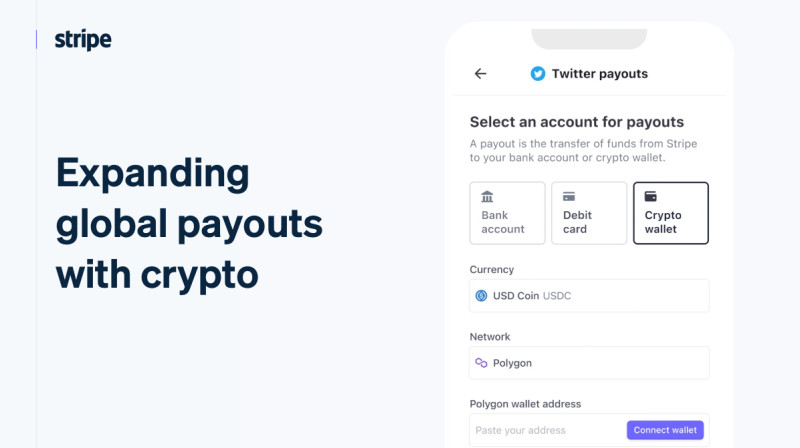
A Stripe post dated April 22, 2022 describes cryptocurrency payout functionality added to Stripe Connect. Stripe presented the service as a way to extend programmable money movement to countries where local payment systems remained difficult to support. Creators, freelancers, sellers, and independent businesses around the world can find customers and fans more easily than before, but receiving payment can remain difficult outside major markets. Stripe says businesses use Connect to send payouts programmatically to recipients in more than 70 countries using local currencies.
Geographic coverage was still constrained by the complexity of heterogeneous local payment systems. Stripe described cryptocurrency as potentially providing open-access global financial rails, in addition to the store of value function that receives more attention. Twitter was the first partner for the crypto-payout pilot. Twitter already used Stripe Connect to pay creators for monetization products including Ticketed Spaces and Super Follows.
With crypto payouts, creators who opted in could have earnings sent to a cryptocurrency wallet. Stripe handled the cryptocurrency-related operations. Platforms did not need to change their code or take on the tasks of acquiring, storing, and transferring cryptocurrency themselves.
The initial payout currency was USDC, a stablecoin pegged to the U.S. dollar. Stripe said this could let people who otherwise could not hold dollars receive and hold a dollar-linked balance. Payouts were processed over the Polygon network. The reasons given for choosing Polygon were low fees, transaction speed, integration with Ethereum, and broad wallet compatibility. Supported wallets named in the post included MetaMask, Coinbase Wallet, and Rainbow. Creators could keep a USDC balance on Polygon or bridge it to Ethereum and exchange it for another currency. Stripe planned to add other networks and payout currencies over time.
Crypto payouts were built into Connect and followed its normal onboarding flow. Stripe performed comprehensive know-your-customer checks and said the flow would change as cryptocurrency regulations evolved. Creators could manage account details, track earnings in real time, view upcoming payouts, and receive payouts through the Stripe Express app. Stripe described the Global Payments and Treasury Network, or GPTN, as its infrastructure and service architecture for programmable money movement. Crypto payouts extended that architecture beyond traditional payment rails. The company planned, by the end of 2022, to support crypto payouts in more than 120 countries.
Data Visualization and Transaction-Analysis Apps
A January 19, 2021 demonstration by Christian Miles describes an interactive Bitcoin transaction dashboard built with KeyLines and KronoGraph. KeyLines is a JavaScript graph visualization library, while KronoGraph is a front-end toolkit for interactive timelines. The example used plain JavaScript without additional dependencies.
The proposed dashboard combined a Bitcoin network chart for connections among entities, a Bitcoin timeline for the order and timing of individual transfers, a live data feed for unconfirmed transactions, alerts tied to wallets, accounts, or locations, controls for pausing, resuming, stopping, and refreshing updates, and a counter showing the approximate Bitcoin value visible in the dashboard. The demonstration uses a Blockchain.info WebSocket endpoint. The browser's native WebSocket function connects to the endpoint and subscribes to all unconfirmed transactions.
Dashboard features
- Network chart for relationships between entities
- Timeline for event sequence and timing
- Live feed of unconfirmed transactions
- Alerts for suspicious wallets, accounts, or locations
- Pause, resume, stop, and refresh controls
- Value counter for visible transactions
The dashboard includes pause, resume, stop, and refresh controls. The demonstration automatically pauses updates when a user zooms into a Bitcoin timeline beyond a specified threshold. This prevents new transactions from overwhelming a detailed investigation view. The network chart can also issue visual alerts for suspicious wallets, accounts, or locations. An alert can notify an investigator as activity occurs, allowing the live feed to be paused for closer examination. A counter in the lower-right corner displays the approximate value of the Bitcoin transactions currently shown in the dashboard. During one 30-minute observation period, the visible transactions were reported as having a total value of $963,401,426.84.
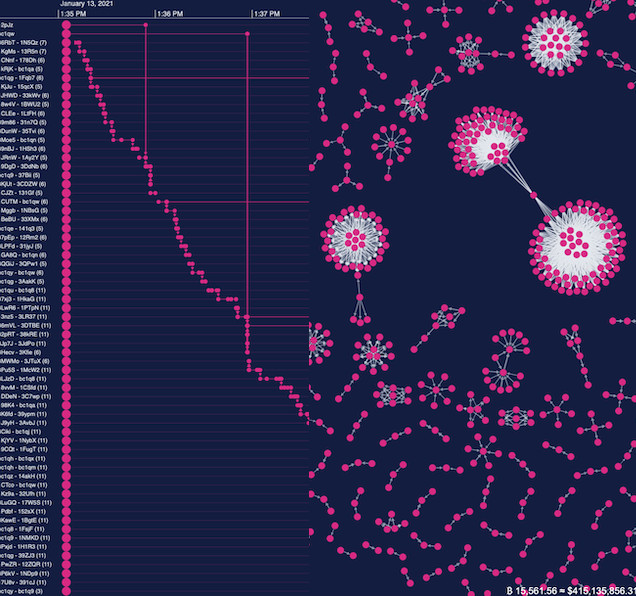
The final application presents network and timeline views of the same live Bitcoin data. The graph exposes connections and patterns, while the timeline exposes timing and sequence. Alerts, update controls, dynamic layouts, zooming behavior, and value tracking add operational features for anti-money-laundering and fraud analysis. This kind of tool is useful if you need to understand transaction flows beyond what a simple how to get a Coinbase wallet guide would cover.
Distinct Roles for Cryptocurrency APIs
Cryptocurrency APIs serve functions beyond accepting and processing payments. A RapidAPI writing project states that most cryptocurrency APIs are not limited to payment processing and can support other application-building tasks. The applications described throughout the material use APIs for distinct jobs: hosted Ethereum node access through services such as Infura and Alchemy, blockchain analytics and historical transaction access, account transaction data through Etherscan, NFT discovery and marketplace data through OpenSea, crypto payouts and recipient onboarding through Stripe Connect, identity and authentication through Okta's OIDC services, application hosting through Firebase, live Bitcoin transaction delivery through Blockchain.info's WebSocket endpoint, network visualization through KeyLines or ReGraph, timeline visualization through KronoGraph, and cross-device portfolio data through custom identity-profile attributes.
This separation means that a dApp may depend on a frontend framework, one or more blockchain node APIs, an authentication provider, a hosting platform, and additional data services. Removing an asset from one marketplace API can also remove it from a wallet or dApp even when its blockchain record remains intact. This is why understanding the API dependencies matters as much as the wallet interface itself. If you are evaluating Crypto.com sign up or any other service, check which APIs it relies on for data.
Blockchain Applications Beyond Cryptocurrency
Blockchain is often associated publicly with Bitcoin, Ethereum, and other cryptocurrencies. Bright Apps, LLC describes blockchain as having applications beyond finance in sectors including supply chains, healthcare, real estate, intellectual property, voting, and energy. In supply-chain management, blockchain can provide a transparent and unalterable ledger for tracing products from origin to consumer. The article uses the food industry as an example. A blockchain ledger could follow produce from farm to table and support food-safety and quality monitoring.
Proposed blockchain applications by sector
- Supply chain management - transparent ledger for tracing products
- Healthcare records - secure and immutable structure for sensitive patient data
- Real estate transactions - reduce paperwork, shorten timelines, lower costs
- Intellectual property and royalties - transparent record of content creation and ownership
- Voting systems - secure, transparent, tamper-resistant platform
- Energy distribution - decentralized grids with shared ledger for producer-consumer transactions
Healthcare applications can use blockchain's secure and immutable structure for sensitive patient data. Proposed uses include streamlining patient-record management, keeping records accurate and consistent, providing access to authorized personnel, supporting secure data-sharing for research, and encouraging collaboration while protecting patient privacy. Real-estate applications can reduce paperwork, shorten transaction timelines, and lower costs. Smart contracts can automate parts of a transaction, including payments and property transfers. A blockchain record can also provide a secure and transparent history of property ownership that can be verified.
Artists and content creators can use blockchain to maintain a transparent and unchangeable record of content creation and ownership. The article identifies royalty tracking and distribution as an application, particularly in music and digital art. These sectors face copyright-infringement problems, and an ownership record can help track how work was created and distributed. Blockchain has also been proposed for voting systems. A secure, transparent, and tamper-resistant platform could support voting and vote counting. Claimed benefits include reducing fraud and counting errors, facilitating remote voting, increasing participation, and improving confidence in electoral processes.
Blockchain can support decentralized energy grids in which consumers generate their own electricity through sources such as solar panels and sell excess energy back to the grid. A shared ledger can record transactions between producers and consumers. The article says this can make energy distribution more transparent and efficient, optimize the system, and reduce costs. Bright Apps characterizes blockchain as a way to improve security, transparency, and efficiency across industries. Its sector examples include unalterable supply-chain records, immutable healthcare data, secure property histories, verifiable creative ownership, tamper-resistant voting, and transparent energy transactions.
These applications operate alongside the application-level dependencies described elsewhere in the material. Blockchain state may be distributed while records, media, identity claims, analytics, marketplace visibility, node access, and user interfaces still depend on permissioned clients, hosted APIs, remote servers, domain owners, authentication providers, and marketplace policies. This is the same pattern we see in wallet apps - the chain is distributed but the view is centralized. If you are researching Fantom wallet review content, apply the same lens: check where the data comes from, not just what the interface shows.
Comments on “How to Compare Cryptocurrency Apps for Wallets, Payments, and Security”
No comments yet. Be the first to share your thoughts.