
How to Compare Cold Wallets for Ripple and Keep Your XRP Safer

XRP and the XRP Ledger
Ripple and XRP are related but distinct. Ripple is a fintech company that provides blockchain-based digital payment services. XRP is the digital asset used for payments, and the XRP Ledger, or XRPL, is the distributed ledger on which XRP transactions are recorded.
The company was founded in 2004 as Ripplepay and later developed RippleNet, a global payments network designed to make cross-border settlement faster, cheaper, and more liquid. XRP is the native asset of the open-source XRP Ledger. The ledger is described as a distributed, permissionless blockchain maintained by peer-to-peer servers known as unique nodes.
Why Cold Storage Matters for XRP
Cryptographic private keys grant transfer or control over digital assets. Securing those keys is therefore central to XRP custody. A wallet does not merely hold a balance; it provides access to assets through the associated key material.
A hot wallet connects to the internet through an app, browser, exchange, or other network-connected system. Hot wallets are convenient for frequent transactions and can provide fast or automated access to liquidity. Ripple describes them as useful for high-frequency, low-risk activity and permissioned use cases that require rapid access to web transactions.
Their constant connectivity creates different risk conditions. An exchange wallet, mobile wallet, browser wallet, or other internet-connected wallet can be exposed to exchange hacks, exchange insolvency or operational failure, frozen or restricted withdrawals, an exchange becoming unavailable without notice, malware, phishing links and fake websites, browser-based tracking, social engineering, compromised credentials, loss of access to an account, and dependence on a third party that holds the keys.
A cold wallet keeps private-key material offline and is generally intended for long-term storage or infrequent transactions. This reduces exposure to internet-connected systems. The stated goal of offline crypto storage is self-custody: the wallet holder retains control of the keys rather than relying on an exchange or centralized custodian to manage the assets.
Hot wallet risk list
- Exchange hacks and insolvency
- Frozen or restricted withdrawals
- Malware and phishing links
- Browser-based tracking
- Social engineering and compromised credentials
- Third-party key custody
One source characterizes cold storage as the only safe choice for long-term XRP holders. The broader custody material presents cold wallets as a way to reduce online and third-party exposure rather than as a universal solution to every operational risk.
Types of Cold Wallets
The source material covers several cold-wallet architectures. Each has different recovery, usability, and maintenance requirements. If you're looking for a crypto currency cold wallet , the options range from hardware devices to simple paper records. Understanding these differences helps you pick the right setup for your needs.
Cold wallet types
- Hardware wallets store private keys in a physical device
- Paper wallets record keys on paper, keeping them offline
- NFC cold wallets use a card and tap-to-sign transactions
- Air-gapped wallets disconnect from all wireless networks
Hardware Wallets
Hardware wallets store private keys in a physical device. They are generally used for offline storage and require a connected interface to sign transactions. The Zypto material characterizes traditional hardware wallets as secure but notes several practical limitations.
They may support only a limited range of assets, often require cables, may require firmware updates, some require desktop software or browser plugins, and accessing funds can be more manual. Ripple's institutional custody analysis likewise describes cold hardware wallets as enhancing security against cyberattacks but potentially creating a manual workflow.
They are best suited to long-term custody, high-security environments, and low-frequency, high-risk transactions. If you want a hard wallet for cryptocurrency that balances security with practicality, a hardware wallet is a solid starting point but not the only option.
Cold hardware wallets enhance security against cyberattacks but can create a manual workflow. Best for long-term custody and low-frequency high-risk transactions.
Paper Wallets
A paper wallet records private keys on paper so that the key material can remain offline. The method can remove an internet connection from the storage process, but it has physical and procedural limitations.
The paper can be lost, damaged by water, fire, or other physical events, or the keys can be exposed when the document is printed. A compromised printer or printing process can copy the keys. A paper copy can be found by an unauthorized person, and there may be no easy way to recover a lost or damaged record.
NFC Cold Wallets
NFC cold wallets use a physical card and tap-to-sign transactions. The card holds or protects key material while a connected mobile application prepares and broadcasts transactions. The Zypto Vault Key Card is presented as an example that combines offline cold storage with mobile convenience without a USB cable.
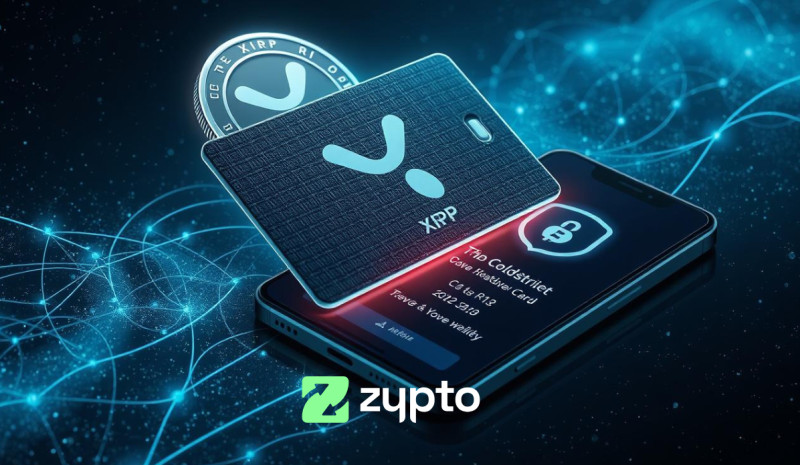
NFC cards are generally described as portable and credit-card sized. Their transaction process still depends on the connected application, so "offline" generally refers to the key-holding card rather than to every part of the transaction workflow.
If you want something that feels like a card you keep in your regular wallet , an NFC cold wallet is worth looking at. It adds physical security without the cable hassle of traditional hardware wallets.
Tangem as a Seedless Option
A wallet comparison presents Tangem as a physical cold-storage card. The stated features are an EAL6+ chip, no seed phrase, and a durable card format intended for long-term storage. Tangem's no-seed-phrase design differs from systems in which a recovery phrase is the foundation of wallet ownership.
Tangem AG states that it provides hardware wallets and non-custodial software solutions for managing digital assets. It also states that Tangem is not regulated as a financial services provider or cryptocurrency exchange, does not hold, custody, or control users' assets or transactions, and that crypto transaction services are provided by third-party providers.
Tangem uses no seed phrase. The physical card and EAL6+ chip distinguish it from conventional hardware wallets and the Zypto Vault Key Card.
How Cold Storage Works for XRP
Understanding how cold storage works for crypto helps you choose the right setup. The basic flow is: the card or cold component protects the key and authorizes signing, the app connects to the relevant network, and the app broadcasts the signed transaction after the user authenticates it.
If you want to know how to store crypto on a cold wallet , the Zypto setup process is a good reference. It consists of five steps: download the Zypto App, set up the Ripple wallet, connect the Vault Key Card which the source says takes only seconds, sign transactions through secure NFC tap authentication, and retain the configured recovery method for access if necessary.
Vault Key Card setup
- Download the Zypto App
- Set up the Ripple wallet
- Connect the Vault Key Card
- Sign via NFC tap authentication
- Retain recovery configuration
The setup description says the user keeps full control and does not need to connect the card to a PC. It also states that the user avoids exchange lockouts and cloud backups. The Vault Key Card is described as available to order exclusively inside the Zypto App.
Seed Phrase Security
A seed phrase is a sequence of words that can recreate a crypto wallet and unlock the assets associated with it. The sources call it the ultimate key or master key to a wallet. Anyone who obtains the phrase may be able to control the XRP and any other assets linked to that wallet.
The stated seed-phrase precautions are clear: never share the phrase with another person, never store it online, never type it into an unknown website, keep it offline and physically secure, and protect it from malware, phishing, malware-infected devices, and compromised applications.
The seed phrase remains a separate recovery concern even when a cold device adds transaction authentication. A card can therefore add security layers without eliminating the need to safeguard recovery information.
The Tangem model is presented as an exception to the seed-phrase model. Tangem is described as using an EAL6+ chip and no seed phrase. The sources do not provide enough information to compare the recovery procedures of the Tangem card and the Zypto card in detail.
Custodial vs Self-Custody
XRP can be stored through a cold wallet, a hot wallet, or a third-party custodian. The appropriate method depends on the holder's risk tolerance, technical comfort, desire for control, need for convenience, and willingness to manage recovery information.
A custodial arrangement places private-key control in the hands of a third party, such as a cryptocurrency exchange, a bank, a fintech, a specialized digital-asset custodian, or a brokerage or asset-management provider. The source says a financial institution may choose outsourced custody for convenience, additional security layers, and access to services such as crypto on-ramps and off-ramps. The trade-off is that the user must trust the custodian to protect the keys and make the assets available when requested.
Self-custody places responsibility for private-key storage and management on the holder. This gives the holder greater control, privacy, and flexibility, but it also transfers responsibility for key protection, backups, authentication, recovery, and operational security to the user.
Institutional self-custody priorities
- Bank-grade security and compliance
- Scalability and flexibility
- Integration with existing systems
- Support for multiple digital-asset use cases
- Ability to become a custodian or issue a stablecoin
Self-custody still requires regulatory compliance when an institution offers digital-asset services. The technical system alone does not remove legal, compliance, or governance obligations.
Institutional Cold Wallet Architecture
Ripple's November 2023 technology analysis describes growing demand for secure institutional custody as digital-asset types, tokenization, and use cases expand. High-net-worth individuals, family offices, enterprises, banks, and financial institutions are identified as potential users of custody solutions.

The analysis identifies three major technology decisions for custody providers. First: whether to use hot, cold, air-gapped, or smart-contract-based wallet architectures. Second: whether to protect private keys with HSMs or MPC. Third: whether to deploy the custody solution as SaaS or on premises. Each choice shapes the security and operational model.
Hot wallets are connected to the web and designed for real-time transactions. They are described as useful for high-frequency activity, low-risk transactions, permissioned use cases, fast access to liquidity, and automated web transactions. Their connectivity makes them more vulnerable to attacks and often requires additional protection technologies.
Cold wallets keep private keys offline within a physical hardware wallet. They reduce exposure to online attacks but can make access more manual. The source associates them with long-term storage, high-security environments, low-frequency high-risk transactions, institutional custody, and assets that do not require immediate liquidity.
Air-gapped wallets are disconnected from all wireless networks, including Wi-Fi and Bluetooth. This creates an additional separation between the wallet and external networks, but it also requires a controlled process for signing and transmitting transactions.
HSMs and MPC for Key Protection
A Hardware Security Module, or HSM, is a physical hardware device or cloud-based module designed to protect cryptographic keys. The source identifies HSM protections including physical security, cryptographic isolation, secure communications, detailed audits and logs, offline or air-gapped operation, long-term storage, and high-level security standards.
HSMs are presented as a strong option for institutions with strict security requirements. They can be used in air-gapped environments, long-term storage facilities, and regulated deployments. The source also notes that an HSM provides little protection if an unauthorized person gains control of the device itself. HSM security therefore depends on physical access controls, governance, administration, auditing, and the surrounding operating environment.
Multiparty Computation, or MPC, is designed to avoid a single point of failure. It cryptographically splits a private key into multiple shares, often described as two or three shards, that can be distributed across separate databases, cloud services, or storage locations. If one shard is compromised, the complete private key remains unusable without the other required shares.
MPC benefits and limits
- Distributed key control
- Reduced dependence on one physical device
- Geographically separated key material
- Fast automated access
- Scalable key management
- Limited to about three or four shards due to performance requirements
MPC also requires additional computational resources. The Ripple analysis states that most MPC solutions are limited to approximately three or four shards because of the performance requirements. MPC is therefore often better suited to fast or automated access, permissioned environments, and institutions that need scalability.
Some MPC providers hold at least one key shard. The source notes that this can mean a bank does not have complete control over its own or its clients' key material. It recommends that the physical storage of key-share material be managed by a single institution when maximum control is required.
Ripple Custody Platform
Ripple Custody is described as an institutional, bank-grade custody platform for secure asset storage, transfer, and settlement. It is intended for institutions that prioritize security, compliance, operational efficiency, and connectivity with digital-asset markets.
The platform is described as providing 24/7/365 asset storage, transfer, and settlement. Ripple identifies BBVA, SG Forge, DBS Bank, and DZ Bank as institutions that trust the platform. Its stated security and compliance features include HSM integrations with IBM Cloud HSM, Thales Luna, and AWS, FIPS certification standards, SOC 2 Type II certification, ISO 27001 certification, EAL 5+ security benchmarks, advanced governance policy controls, cryptographically protected process flows, transaction-security enforcement, multi-tenancy for institutional custody hierarchies, runtime verification of transactions, monitoring for unauthorized modifications, malicious transactions, and audit tampering, and integrations with Elliptic and Chainalysis for blockchain analytics.
The governance engine is described as enforcing cryptographically protected process flows and verifying transactions at runtime. Ripple states that this prevents unauthorized modifications, malicious transactions, and audit tampering within the platform's operating model. Elliptic and Chainalysis integrations are used to screen transactions and support Know Your Customer, Anti-Money Laundering, and Countering the Financing of Terrorism requirements.
The platform is positioned for institutions that need a managed custody provider rather than direct control of an individual cold wallet. Its infrastructure is based on institutional HSM and governance systems rather than a single consumer hardware device.
Cold Wallet Recovery and Loss
Recovery is a critical differentiator across cold wallet types. A seed phrase can restore access if the device is lost, but it must be protected as the master key. A card-based system may use a combination of card, PIN, optional biometrics, app configuration, and recovery credentials.
For cold storage for crypto , recovery architecture matters a lot. The Vault Key Card is not described as the only recovery factor. The user must maintain the recovery configuration associated with the Zypto App. The source says that if the card is lost, access can be recovered through that configured setup. This differs from a paper wallet, where the physical record of the private key may itself be the only backup. It also differs from the Tangem description, which states that Tangem uses no seed phrase.
Losing a cold wallet card does not necessarily mean losing access, provided the recovery setup remains available. The exact recovery architecture of every cold wallet is important when comparing products.
Comparing Cold Wallet Options
When evaluating what are the best crypto cold wallets , the sources point to several comparison factors. Key isolation matters: cold wallets keep private-key material offline while hot wallets remain connected to internet-facing systems. Air-gapped hardware adds further network separation. Tangem and the Vault Key Card use physical cards, while the Vault Key Card also uses NFC signing and a connected app.
Control and third-party dependence is another axis. Self-custody places responsibility for keys and recovery on the holder. Exchange, brokerage, bank, and institutional custody arrangements delegate some or all key management to a third party. The corresponding trade-off is control versus convenience, accessibility, and reduced operational responsibility.
Connectivity varies across options. Hardware wallets may require USB cables, desktop software, or browser plugins. The Vault Key Card uses encrypted NFC instead. Paper wallets require no connected device after generation but create physical-storage risks. The Zypto App remains involved in transaction broadcasting even when the card handles signing.
Transaction frequency shapes the choice. Hot wallets are positioned for frequent or automated activity. Cold and air-gapped wallets are positioned for long-term custody and infrequent transactions. Paper wallets are also offline but are limited by the physical handling of the key record.
Asset support is worth checking. The Vault Key Card is described as supporting XRP, XRPL tokens, and more than 24,000 other cryptocurrencies or assets. Generic hardware wallets may support fewer assets and may require firmware or software updates. Tangem is described as a durable card with an EAL6+ chip and no seed phrase, but the available material gives fewer XRP-specific compatibility details.
Security Claims and Limitations
Cold storage can reduce exposure to online attacks, exchange withdrawals, malware, phishing, and third-party custody risk. It does not remove every risk. A poorly generated recovery phrase, compromised device, lost authentication factor, malicious application, physical theft, or human error can still affect the wallet.
When looking for the best cold wallet storage , keep in mind that no single solution covers every scenario. The March 2025 Ripple custody analysis gives the Bybit exchange hack as an example of the risks. The attack resulted in $1.46 billion in stolen digital assets and was attributed to social engineering that manipulated a third-party user interface. Authorized signers were tricked into approving a fraudulent transaction, allowing attackers to access assets.
Cold storage reduces online exposure but does not eliminate every risk. A poorly generated recovery phrase, compromised device, or human error can still affect the wallet.
A multi-layered institutional custody framework may include multisignature authentication, multiple approvals for transactions, hot-warm-cold-air-gapped wallets, cloud or on-premise deployment, HSM or MPC key protection, governance policies, regular audits, redundant systems, user and employee security training, compliance controls, and transaction monitoring.
Historical XRP Hot-Wallet and Cold-Wallet Setup
An October 2017 XRP API introduction describes a presentation for people assisting exchanges that support XRP. The presentation was intended to last one to two hours and was designed to help participants understand the key concepts of the XRP Ledger, identify the essential Ripple developer documentation, and create both a hot wallet and a cold wallet that could be used immediately.
The historical material uses the term "Ripple address" for an XRP account. The presentation was built around a browser-based slide deck that ran commands rather than displaying only previously captured output. An early example displayed live server_info results, including fields such as uptime and completed ledgers that changed while the presentation was running.
The presentation generated public and private keypairs in the browser. The source says that the keypairs belonged to the viewer, were known only to the viewer, and could be used immediately on Ripple's test network. It also generated an actual hot wallet and cold wallet on the test network by executing the relevant commands behind the scenes.
This early example illustrates the basic distinction that remains relevant to XRP storage: a hot wallet is connected to network services and can be used for online operations. A cold wallet keeps key material in a separate offline environment and uses an authorized signing process. Public and private keypairs must be generated and handled securely. Test networks can be used to practice the workflow before using real assets.
XRP Market Context for Storage Decisions
XRP had a market capitalization of more than $88 billion and was described as a top-ten cryptocurrency by market value. The all-time high was $3.84 during the 2017-2018 bull market. It fell to approximately $0.15 in mid-2020 and reached another low of approximately $0.38 in July 2024 before gaining almost 600% in the months following that low.
The July 2024 recovery was attributed to positive cryptocurrency sentiment following the November 2024 US election, progress in the SEC case against Ripple, greater use of the network, and the launch of spot XRP exchange-traded funds in late 2025. A $19 billion liquidation event on October 10, 2025, during a broader bearish cryptocurrency market, shows that market conditions can leave cryptocurrency prices below earlier highs, although past performance does not establish future results.
Caleb and Brown lists an average XRP transaction fee of approximately $0.0002. For cross-border use, XRP fees can be below $0.01, while traditional transfer or currency-conversion fees can reach as much as $50. The network is described as capable of handling up to 1,500 transactions per second, with settlement in less than five seconds.
Ripple Adoption and Network Developments
RippleNet is described as providing real-time gross settlement for financial institutions. Santander, Standard Chartered, Travelex Bank, American Express, and Mitsubishi UFJ are among the institutions named as users or supporters of Ripple's payment technology. By 2017, the source says 100 financial institutions had joined the Ripple network.
Korean remittance provider SentBe reportedly saved customers $25 million in foreign-exchange conversion and transaction fees by using RippleNet. Travelex Bank is also described as using Ripple's global payments network for near-instant cross-border settlement. Ripple announced a $500 million strategic private funding round in November 2025, valuing the company at approximately $40 billion. The round included institutional investors Fortress Investment Group and Citadel Securities, with participation from Brevan Howard, Marshall Wace, Galaxy Digital, and Pantera Capital.
Spot XRP exchange-traded funds launched in late 2025. According to the guide, Canary Capital's spot XRP ETF received $250 million in inflows on its launch day, five spot XRP ETFs were available, more than $2.5 billion in assets were held across those funds, and spot XRP ETFs had received $148 million in net inflows during 2026 through the time of writing. Ripple's RLUSD stablecoin launched on December 17, 2024, denominated in U.S. dollars and issued by Standard Custody and Trust Company, with a market capitalization reported at $1.5 billion.
Choosing Your Cold Wallet Setup
The Zypto article presents use-case choices for XRP storage. For maximum security, use the Zypto App with the Vault Key Card. For privacy, prepaid crypto debit cards with soft KYC require no documents in most cases. For a balance of usability and safety, the Zypto App with Vault Key Card protection works. For business use, Zypto Pay extends the company's security approach to crypto payment processing.
If you're weighing a crypto vault versus a wallet , the distinction matters. A vault implies stronger isolation and fewer access points, while a wallet implies more frequent interaction. The Zypto setup leans toward wallet-like convenience with card-based security.
The stated authentication model has three possible elements: a PIN, physical possession of the Vault Key Card, and optional biometric verification through the connected device. The card is tapped against the phone or NFC reader to authorize a transaction. The private key does not need to be typed into a website or copied into a desktop application during signing.
The three-factor model means the card is only one part of access control. If the card is lost, recovery depends on the configured recovery setup in the Zypto App. The source says that a user can recover access through that setup and does not describe the card as the sole key to the wallet.
The Zypto App is described as the interface used to store XRP and link the wallet to the Vault Key Card. The card is intended to retain cold protection while the app provides access to transaction and payment functionality. App functions include paying bills with XRP through Bill Pay, buying gift cards from thousands of brands, topping up mobile phones globally, connecting XRP holdings to crypto cards for spending, and supporting secure signing of transactions through the card.
DeFi and Other Supported Features
The Zypto FAQ states that some cold wallets can support DeFi features through a linked application while keeping transaction signing in the cold component. In the case of the Vault Key Card, the app can provide supported wallet functions while the card handles authorization.
The source describes the Zypto App as supporting more than 24,000 assets and links the cold card with payment, gift-card, mobile-top-up, and crypto-card functionality. The app and card are not presented as a full desktop node or as a replacement for every online service. They are presented as a mobile application plus a separate signing and authentication device.
There is a notable difference in how the sources describe the role of the app. One FAQ describes the Vault Key Card as not requiring cables, apps, or firmware. The same product documentation says the card is designed exclusively for use within the Zypto App, and the setup instructions require downloading the app and linking the Ripple wallet to the card. The broader descriptions clarify that the card operates offline for transaction authorization while the Zypto App is required to prepare and broadcast transactions.
Maintenance and Long-Term Storage
The sources present several factors that can be compared when evaluating XRP storage. Key isolation matters: cold wallets keep private-key material offline while hot wallets remain connected to internet-facing systems. Air-gapped hardware adds further network separation.
Maintenance requirements vary. Traditional hardware wallets may require firmware updates, USB connections, desktop applications, or browser plugins. The Vault Key Card is presented as avoiding those requirements. Paper wallets require secure generation, physical storage, and careful backup handling.
For individual users, the choice may be a hardware card, NFC card, paper wallet, or hot wallet according to personal preferences. Banks, fintechs, family offices, and other institutions may require HSMs, MPC, multisignature approval, governance policies, cloud deployment, on-premise infrastructure, and compliance controls.
The appropriate combination of wallet type, key-protection technology, and deployment model depends on the provider's digital-asset use cases and the institution's risk and operating requirements. Cold storage can reduce exposure to online attacks, exchange withdrawals, malware, phishing, and third-party custody risk, but it does not remove every risk.
Comments on “How to Compare Cold Wallets for Ripple and Keep Your XRP Safer”
No comments yet. Be the first to share your thoughts.